INCOME TAX
IT’S TIME FOR A FAIRER INCOME TAX IN MICHIGAN
Updated April 2026 | Nicholas Hess, Fiscal Policy Analyst

-
- Michigan has a flat income tax of 4.25%, meaning that everyone from all income groups pays the same tax rate.
- Personal income tax accounted for 30.6% of state revenue in 2023. In the past few years, Michigan has taken in more corporate taxes, due to record profits, with the second biggest source of revenue coming from sales and use taxes, another regressive tax.
- A “trigger” introduced in 2015 took effect in 2023, temporarily reducing the income tax rate from 4.25% to 4.05%, reverting to 4.25% in 2024. The income tax trigger was not met in 2024 or 2025.

-
- Michigan should enact a graduated income tax (GIT), requiring those who earn more to pay more. Not only will this bring in more revenue to the state, but it will establish a more equitable system.
- Along with expanding eligible beneficiaries for the Earned Income Tax Credit (EITC), Michigan should adopt a refundable Child Tax Credit (CTC) as well as a refundable Child and Dependent Care Tax Credit.
- Michigan should eliminate the income tax trigger.

Personal income tax represents the largest single source of state tax revenue. The majority of income tax revenue is allocated to General Fund/General Purpose (GF/GP) spending with the bulk of the remainder going to the School Aid Fund (SAF).
Michigan’s personal income tax was first enacted in 1967 at a rate of 2.6%. The rate fluctuated over the years, reaching a high of 6.35% in 1983 before finally settling to the current rate of 4.25% following tax changes in 2011.[1]
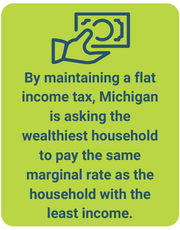
Michigan’s flat tax structure, found in only 14 states,[2] means all income earners are subject to the same tax rate regardless of how much they earn (known as the tax base). A person earning $30,000 a year pays the same rate as someone earning $500,000. This is known as a proportional tax, where the tax is a specified proportion of a person’s income, as opposed to a regressive tax, which is disproportionately burdensome on people with low incomes. While the vast majority of states who tax income have a graduated income tax, meaning the rate rises with income, the Michigan Constitution explicitly bans the state from adopting this fairer tax structure, and changing this requires a ballot initiative.
-
- Rate = The percent of income owed
- Base = The taxpayer’s net taxable income, generally adjusted income after deductions and exemptions
The state Supreme Court even held that phasing out personal exemptions or deductions for earners with higher incomes, as was attempted in the 2011 income tax reforms, created an unconstitutional graduated income tax. [3]
Trickle-down is a trick
On paper, the income tax is fair and uniform, but there is a difference between a statutory tax and an effective tax. Different groups of taxpayers pay the same rate, but as covered in the overview section of this resource, higher-income earners pay a lower overall effective rate when including property and sales taxes, thus the responsibility of paying for public amenities falls disproportionately on the bottom and middle income groups. Even though Michigan’s income tax structure is more progressive than others, the flat tax contributes to the regressivity of the state’s tax system overall because the effective rates collected from earners with lower incomes cannot overcome high sales and property taxes.
In fact, compared to systems with a progressive income tax, families with middle incomes end up paying more under a flat tax regime, especially if certain tax exemptions are also not repealed for high-income earners. Tax cuts for earners with high incomes do not materialize into more economic growth, compared to tax cuts for earners with middle or low incomes. This is because households with middle or low incomes spend more of the money they receive from tax credits, compared to high-income households who tend to be able to afford to put those dollars into savings (known as the marginal propensity to consume). Compared to states with graduated income taxes, the suggested benefits of a flat tax do not materialize as theory suggests.[4]
It is worth noting, however, that the income tax is one of Michigan’s most progressive elements because it funds various public programs that benefit households with middle or low incomes.
Additionally, when policymakers reduce taxes for wealthy people and profitable companies, they often raise taxes on everyone else to offset the loss of revenue. Michigan is a prime example of this. In 2011 when business taxes were cut, Michigan lawmakers offset those by raising taxes on individuals and families. Michigan is not alone — several states over the last decade have slowly scaled back their tax rates, putting more onus on households with modest incomes.[5] Taxing high-income households will not only pay for public services and poverty-combatting programs (like the CTC and EITC), but will also help reduce income inequality.

The ban on a GIT (also known as a progressive tax) is one of the key features contributing to inequities in Michigan’s tax system. By maintaining a flat income tax, not only is it asking the wealthiest households to pay the same tax rate as those with lower incomes, the flat tax also makes it difficult for Michigan to narrow racial income and wealth gaps.
Decades of discrimination in housing, education and the workplace have contributed to large disparities in the incomes of households of color compared to white counterparts. And while overt legal discrimination is prohibited, discrimination along class lines is maintained, which contributes to keeping these racial gaps alive. Compared to the Michigan average earnings of $71,150 annually, Black households earn $44,133, Indigenous/Native American households earn $56,268 and Hispanic/Latino households earn $63,924 on average. Meanwhile, white households earn an average of $75,833 per year.[6] Our tax system favors the latter at the expense of the former, placing a disproportionate burden on households with low incomes and families of color to fund the public coffers.[7]
Because white households are overrepresented in the top 5% of incomes while Black, Indigenous, and Hispanic households are overrepresented in the bottom 20%, a flat income tax tends to benefit white households.

Personal income tax exemptions, deductions and credits help make Michigan’s income tax marginally progressive by reducing the effective income tax rate paid by Michiganders with low and moderate incomes, which helps offset the regressive nature of the state and local tax systems. One of the best ways we bring equity to our income tax is through the EITC, a tax credit targeted to families with low incomes and one of the most effective anti-poverty tools to date.[8] Michigan piggybacks off of the federal EITC, setting the state credit at a percentage of the federal credit. Importantly, Michigan’s EITC is refundable, meaning it will be paid in full to households even if they owe $0 in taxes. In contrast, nonrefundable tax credits only pay up to the point where they offset your tax dues. So, for a family that owes $0 in taxes, nonrefundable credits provide no benefit, which often leaves out households with the greatest need.
In 2023, Michigan lawmakers increased the state credit from 6% to 30% of the federal credit, resulting in an $836 average credit for tax year 2023. Progressive tax credits like the EITC are associated with higher levels of economic and intergenerational mobility, higher test scores for children and lower levels of food insecurity.[9][10] Furthermore, the EITC helps hardworking families make ends meet such as paying for transportation to get to their job.
However, the EITC still leaves out groups such as workers below the age of 25 and those over the age of 64 who aren’t raising children and those who file with individual taxpayer identification numbers (ITIN). These include vulnerable populations, like youth exiting foster care and children in immigrant families, and results in them paying higher overall effective tax rates.
Other tax credits that will improve equity within Michigan’s tax system are the Child Tax Credit (CTC) and Child and Dependent Care Tax Credit (CDCTC). Currently, Michigan does not offer a statewide CTC or CDCTC, which are credits that help families offset the high costs of raising a child. While the CTC provides a tax credit for children under the age of 17 for recipients, the CDCTC is a credit to help families cover the high cost of child care, including before- and after-school care and summer care.[11][12] In 2021, the American Rescue Plan provided a temporary increase to both credits, which helped cut national childhood poverty by more than half.[13] The largest demographic living in poverty are children, with 20% of Michigan children ages 0-4 and 17% of children ages 5-17 living in poverty.[14] The CTC is one of many effective policies that combat this depressing statistic. The CTC and CDCTC can also act as financial cushions for families struggling to make ends meet, which reduces poverty for parents as well. Michigan families and their children deserve to have access to all the tools they need to succeed.

In 2015, Michigan implemented an income tax rate reduction trigger, which took effect in 2023. The trigger states that when revenue growth for Michigan’s General Fund (GF/GP) exceeds the rate of inflation by 1.425 times, the income tax rate will automatically decrease temporarily. Several Michigan courts have held that while the law requires an automatic reduction during years in which conditions are met, this is a temporary reduction, and the rate will revert to the statutory rate of 4.25% in other years.[15]
The primary problem with the trigger is how it interacts with unknown economic conditions and state fiscal policies. Economic events, changes in federal tax policy, or modifications to state tax and spending policies causing one-time revenue jumps could trigger reductions even if they do not reflect anticipated long-term revenue growth.[16] A prime example of this is what occurred in 2023, the first year the law took effect and the year the triggering conditions were met. Despite a national public health crisis and high inflation, pandemic-era policies, like economic impact payments and an improved federal Child Tax Credit, and temporary changes in consumer habits resulted in higher than expected GF/GP revenues. This unpredictably strong revenue growth during 2022 forced the triggered rate reduction to take effect, reducing Michigan’s income tax rate from 4.25% to 4.05%. This resulted in a $714 million revenue reduction for the state.[17]

1.) Michigan should take steps to enact a graduated income tax and join the 27 other states in the country that do so. While this action will require a constitutional change, a graduated income tax would enable the state to collect a greater share of taxes from high-income earners and could even pave the way for a millionaire’s tax. These progressive changes would contribute to greater equity and revenue sufficiency in Michigan’s tax code.
2.) In addition to expanding access to the EITC, Michigan should adopt refundable state versions of the CTC and CDCTC. All three of these tax credits should be stackable as well as refundable, providing much-needed financial cushions for hardworking families struggling to make ends meet, especially in this era of unpredictable price movements. All of these tax credits respect the autonomy of its recipients, effectively reduce poverty, cushion against financial hardships, and have broad bipartisan support.
3.) Michigan should eliminate the income tax trigger. Its flawed design, which fails to account for ever-changing economic conditions, will have significant negative consequences for the state. Insufficient revenue resulting from this mechanism will lead to recurring budget shortfalls and cuts to important state programs if the trigger is not repealed.

[1] Elizabeth Pratt and David Zin. “History of the Michigan Individual Income Tax Rate.” State Notes. Senate Fiscal Agency, Spring 2015. https://www.senate.michigan.gov/SFA/Publications/Notes/2015Notes/NotesSpr15lpdz.pdf.
[2] Walczak, Jared, and Katherine Loughead. “The State Flat Tax Revolution: Where Things Stand Today.” Tax Foundation, October 8, 2025. https://taxfoundation.org/data/all/state/flat-tax-state-income-tax-reform/.
[3] “Advisory Opinion Regarding Constitutionality of 2011 PA 38.” State of Michigan Supreme Court, November 18, 2011. https://www.courts.michigan.gov/…/advisoryopn-op.pdf.
[4] Davis, Carl and Eli Byerly-Duke. 2025. “The Pitfalls of Flat Income Taxes.” Institute on Taxation and Economic Policy. https://itep.org/the-pitfalls-of-flat-income-taxes-2025/.
[5] Tharpe, Wesley. 2023. “States’ Recent Tax-Cut Spree Creates Big Risks for Families and Communities.” Center on Budget and Policy Priorities. November 30, 2023. https://www.cbpp.org/…/states-recent-tax-cut-spree.
[6] “An Ecosystem of Health Disparities and Minority Health Resources.” n.d. National Institute on Minority Health and Health Disparities. U.S. Department of Health & Human Services. https://hdpulse.nimhd.nih.gov/data-portal/quick-profile/26/social.
[7] Boddupalli, Aravind, Janet Holtzblatt, and Lillian Hunter. 2024. “A Guide to Understanding Racial Disparities in the Federal Individual Income Tax System.” Tax Policy Center. June 13, 2024. https://taxpolicycenter.org/…/racial-disparities.pdf.
[8] “How Does the Earned Income Tax Credit Affect Poor Families?” Tax Policy Center. 2023. https://taxpolicycenter.org/…/affect-poor-families.
[9] Chetty, Raj, Harvard University, John N Nber, and Friedman. 2012. “New Evidence on the Long-Term Impacts of Tax Credits.” https://www.irs.gov/pub/irs-soi/11rpchettyfriedmanrockoff.pdf.
[10] McInnis, Nicardo, Katherine Michelmore, and Natasha Pilkauskas. 2023. “The Intergenerational Transmission of Poverty and Public Assistance – Evidence from the Earned Income Tax Credit.” https://www.nber.org/…/w31429.pdf.
[11] “What Is the Child Tax Credit?” Tax Policy Center. April 2024. https://taxpolicycenter.org/…/what-child-tax-credit.
[12] “Child and Dependent Care Credit Information.” Internal Revenue Service. January 10, 2025. https://www.irs.gov/…/child-and-dependent-care-credit-information.
[13] “Expanded Child Tax Credit Is Key to Reducing Child Poverty, New Census Data Illustrate.” Institute on Taxation and Economic Policy. 2024. https://itep.org/new-census-data-child-poverty-expanded-child-tax-credit/.
[14] “ALICE in Focus: Children in Financial Hardship.” Michigan Association of United Ways. September 1, 2024. https://unitedforscmi.org/…/ALICE-in-Focus.pdf.
[15] Egan, Paul. Review of Michigan Supreme Court Dismisses Case Calling for a Permanent Income Tax Cut. Detroit Free Press. August 30, 2024. https://www.freep.com/…/75016772007/.
[16] Lowe, Suzanne, and David Zin. Review of Senate Bill 414. Senate Fiscal Agency. November 4, 2015. https://legislature.mi.gov/…/2015-SFA-0414-E.pdf.
[17] Gibbons, Lauren. Review of Michigan Income Tax Cut Not Permanent, Court Rules. Bridge Michigan. March 7, 2024. https://www.bridgemi.com/…/income-tax-cut-not-permanent.

 Betsy Zobl-Tar
  Jay Cutler joined the League in March 2026 as the Kids Count Senior Data Analyst, where he collects, analyzes, and prepares data for Kids Count in Michigan.
 Danielle Taylor-Basemore joined the League as the Development Data and Stewardship Coordinator in June 2025. She brings with her five years of nonprofit experience with a special focus on community engagement, data visualization and strategic programming. Prior to joining the League, Danielle served as the Business District, Safety, and Digital Manager at Jefferson East, Inc.
 Scott Preston is a Senior Policy Analyst with the Michigan League for Public Policy, where he leads the organization’s immigration and criminal justice reform portfolios. In the three years prior to joining the League, Scott facilitated the Southeast Michigan Refugee Collaborative and managed a small business economic development program at Global Detroit. His work included launching Michigan’s first Refugee Film Festival and building on a trusted connector model that linked marginalized communities with crucial resources. Scott’s work at the League is informed by his background in journalism and research. He spent four years covering the Syrian refugee crisis in the Middle East for publications such as The Economist, and later worked with unaccompanied refugee minors through Samaritas. Scott holds a master’s degree in international migration and public policy from the London School of Economics and Political Science.
 Kate Powers joined the League as the Chief Development Officer in February 2025. Prior to joining the League, Kate held leadership positions at many Michigan nonprofit organizations, most recently serving as the COO and Chief Development Officer of Ele’s Place. Kate has spent the bulk of her career in fundraising, with a short stint in the state Legislature as a legislative aide to members in both chambers. Kate is a graduate of Michigan State University’s James Madison College with a Bachelor of Arts in Social Relations and has a certificate in fundraising management from the Lilly Family School of Philanthropy at Indiana University. Additionally, Kate served on the East Lansing Public Schools Board of Education and is a past President of the Junior League of Lansing. In her free time, she enjoys traveling with her husband and her son and saving outfit of the day and home decor ideas on Pinterest.
  Nicholas Hess joined the League as the Fiscal Policy Analyst in September of 2024. In this role, Nicholas focuses on tax policy, government revenue, and their impact on working families and racial equity, including the effects of the Earned Income Tax Credit (EITC) and Child Tax Credit (CTC). Nicholas values the role that judicious fiscal policy can play in the improvement of people’s lives and the economy, alleviating inequities along the way.
 Audrey Matusz joined the League as the Visual Communications Specialist in September 2024. She supports the team with implementing social media strategies and brainstorming creative ways to talk about public policy. She brings with her nearly a decade of experience in producing digital products for evidence-based social justice initiatives.
  Jacob Kaplan
  Donald Stuckey
  Alexandra Stamm
 Amari Fuller
 Mikell Frey is a communications professional with a passion for using the art of storytelling to positively impact lives. She strongly believes that positive social change can be inspired by the sharing of data-driven information coupled with the unique perspectives of people from all walks of life across Michigan, especially those who have faced extraordinary barriers.



 Yona Isaacs (she/hers) is an Early Childhood Data Analyst for the Kids Count project. After earning her Bachelor of Science in Biopsychology, Cognition, and Neuroscience at the University of Michigan, she began her career as a research coordinator in pediatric psychiatry using data to understand the impacts of brain activity and genetics on children’s behavior and mental health symptoms. This work prompted an interest in exploring social determinants of health and the role of policy in promoting equitable opportunities for all children, families, and communities. She returned to the University of Michigan to complete her Masters in Social Work focused on Social Policy and Evaluation, during which she interned with the ACLU of Michigan’s policy and legislative team and assisted local nonprofit organizations in creating data and evaluation metrics. She currently serves as a coordinator for the Michigan Center for Youth Justice on a project aiming to increase placement options and enhance cultural competency within the juvenile justice system for LGBTQIA+ youth. Yona is eager to put her data skills to work at the League in support of data-driven policies that advocate for equitable access to healthcare, education, economic security, and opportunity for 0-5 year old children. In her free time, she enjoys tackling DIY house projects and trying new outdoor activities with her dog.
 Rachel Richards rejoined the League in December 2020 as the Fiscal Policy Director working on state budget and tax policies. Prior to returning to the League, she served as the Director of Legislative Affairs for the Michigan Department of Treasury, the tax policy analyst and Legislative Director for the Michigan League for Public Policy, and a policy analyst and the Appropriations Coordinator for the Democratic Caucus of the Michigan House of Representatives. She brings with her over a decade of experience in policies focused on economic opportunity, including workforce issues, tax, and state budget.
 Simon Marshall-Shah joined the Michigan League for Public Policy as a State Policy Fellow in August 2019. His work focuses on state policy as it relates to the budget, immigration, health care and other League policy priorities. Before joining the League, he worked in Washington, D.C. at the Association for Community Affiliated Plans (ACAP), providing federal policy and advocacy support to nonprofit, Medicaid health plans (Safety Net Health Plans) related to the ACA Marketplaces as well as Quality & Operations.

 Renell Weathers, Michigan League for Public Policy (MLPP) Community Engagement Consultant. As community engagement consultant, Renell works with organizations throughout the state in connecting the impact of budget and tax policies to their communities. She is motivated by the belief that all children and adults deserve the opportunity to achieve their dreams regardless of race, ethnicity, religion or economic class.


 Emily Jorgensen joined the Michigan League for Public Policy in July 2019. She deeply cares about the well-being of individuals and families and has a great love for Michigan. She is grateful that her position at the League enables her to combine these passions and work to help promote policies that will lead to better opportunities and security for all Michiganders.
 Megan Farnsworth joined the League’s staff in December 2022 as Executive Assistant. Megan is driven by work that is personally fulfilling, and feels honored to help support the work of an organization that pushes for more robust programming and opportunities for the residents of our state. She’s excited and motivated to gain overarching knowledge of the policies and agendas that the League supports.