
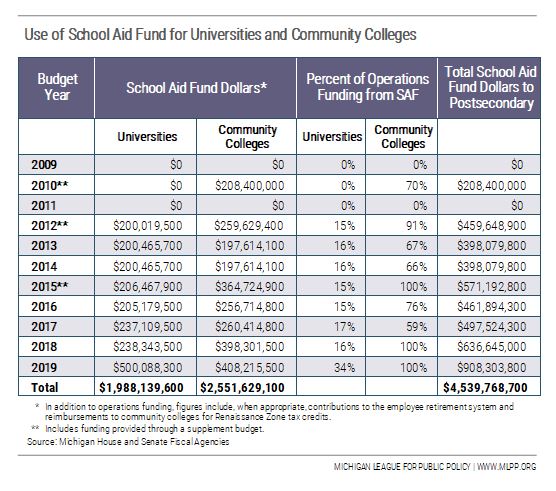
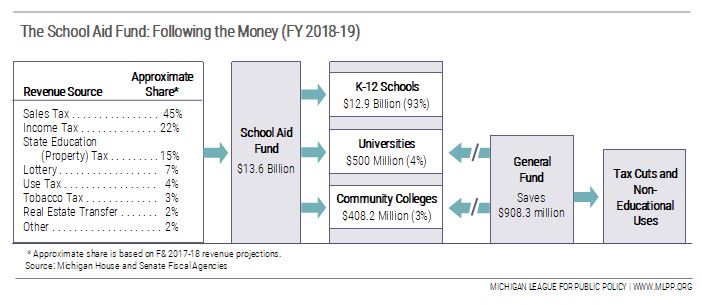
A one-time fix to help balance the state budget has now become regular practice in the annual appropriations process. Michigan has shifted a total of $4.5 billion intended for K-12 public schools to universities and community colleges since 2010, including a record $908 million for the upcoming budget year. This cut to K-12 education was not done for the benefit of postsecondary education, but to balance the state budget and compensate for General Fund dollars that are increasingly stretched thin due in large part to tax cuts for businesses.
 The School Aid Fund (SAF) was first established in 1955 as an amendment to the 1908 Michigan Constitution, retained in the 1963 constitution, and transformed through Proposal A of 1994. From the time it was first established until Budget Year 2010, the School Aid Fund had been used exclusively to fund Michigan’s K-12 schools.1 Funding for postsecondary education, on the other hand, came from the General Fund. For 2010, in order to balance a state budget that had been beaten down over the past decade by tax cuts and the Great Recession, Governor Jennifer Granholm and the Michigan Legislature used a supplemental bill to appropriate $208.4 million in SAF dollars to community colleges. The one-time appropriation included language stating that “funds appropriated to community colleges from School Aid Fund [will] be considered a loan” that “will be repaid from General Fund to School Aid Fund over the period of FY 2011-12 to FY 2015-16.”2 The Legislature never paid the funds back.
In Budget Year 2012, Governor Rick Snyder’s first budget drew from the School Aid Fund to replace General Fund dollars going to universities and community colleges, with no language stating it needed to be repaid. In its final form, the nearly $400 million taken from K-12 was accompanied by a $470 per pupil cut in the K-12 foundation allowance—the only year since Proposal A in which the foundation allowance was statutorily cut.3 The cut was accompanied by a very large tax cut for businesses that cost $1.6 billion, with only part of that amount made up by increased taxes on individuals. The Legislature later passed a supplemental budget that took an additional $63.7 million from the School Aid Fund to pay for community college operations, for a total of $459.6 million in SAF dollars shifted from K-12 to postsecondary institutions in 2012.
This shift has been the norm during the past eight years, as every budget introduced by the Snyder administration and passed by the Legislature has shifted at least $350 million—and often more—from K-12 public schools to universities and community colleges.4
A Growing Dependence on the School Aid Fund
The precedent begun by the administration and Legislature in 2012 has led to a growing dependence on SAF dollars to fund postsecondary education rather than finding the dollars for that use in the General Fund. Three of the past five budgets have funded community college operations entirely from the School Aid Fund, and the most recent budget more than doubles the SAF dollars going to universities. In Budget Year 2019, rather than reversing a practice that started as a one-time budget solution in the lean years of the Great Recession, the Legislature dug in its heels and shifted a record high $908.3 million from K-12 to postsecondary education.
Why Are Michigan’s Elected Leaders Using School Aid Fund Dollars for Postsecondary Education Rather Than Enhancing K-12 Education?
For Budget Year 2012, a larger SAF balance than initially expected led to hopes that the per-pupil allowance would be increased, but the money was shifted to postsecondary education instead and the allowance was reduced by $470. This shift did not benefit universities and community colleges, as an equivalent amount of General Fund money was subtracted from their funding and the amount they received only increased at the level it normally does each year for inflation. In 2012 and every budget year since, the shift only serves to increase General Fund dollars available for other uses, including tax cuts and credits that reduce revenue to the state unless made up elsewhere. Examples of such tax expenditures include:
- the 2012 tax shift favoring businesses
- legacy business tax credits
- the repeal of the personal property tax
- triggered income tax rate cuts
- small property and sales tax exemptions
- the increase in the personal exemption
The governor and Legislature have chosen to rely on shifting educational funds to balance the state budget rather than addressing the underlying issue: the shortage of General Fund money due to large tax cuts the state could not afford, particularly those enacted in Budget Year 2012. Rather than make difficult decisions regarding how to restore the lost state revenues, elected leaders year after year have resorted to taking School Aid Fund dollars from K-12 education, using it to fund postsecondary education, and subtracting a roughly equal amount of postsecondary education funding and putting it back into the General Fund to help make up for shortfalls created by tax cuts. Following the money leads to only one conclusion: the state is paying for tax cuts with money taken from its K-12 students.

How Could Michigan Have Strengthened Public Education with the $908 Million Taken from the School Aid Fund?
The $908.3 million in SAF dollars shifted to universities and community colleges in Budget Year 2019 could have gone into K-12 classrooms, improving educational achievement, reducing inequities based on race, income and place, and helping more Michigan children become college- and career-ready. Here are some ways in which the School Aid Fund should have been used to improve outcomes for schoolchildren:
Increase the Foundation Allowance: In the 2018 budget year, 63% of Michigan public school students were in districts receiving the minimum foundation allowance of $7,631. The 2019 budget increases the minimum foundation allowance by $240 per pupil, to $7,871. While this sounds like a significant increase, it leaves the minimum allowance far below the level prior to the Budget Year 2012 cut when adjusted for inflation. Although the foundation allowance has been raised in small amounts each year since, the 2018 minimum allowance of $7,631 was equal to only $6,780 in 2011 dollars—a 7% drop in purchasing power. In 2018, per-pupil funding would have had to be $8,234 in order to equal the 2011 level.
Bringing the per-pupil funding back up to its 2011 level in real dollars is not enough, however. The Michigan School Finance Research Collaborative, a nonpartisan group of education experts, school officials, business leaders, public policy advocates and others, has recommended that schools receive a base cost of $9,590 per pupil, with additional funding weighted by the number of students in poverty, the number of English language learners, district size, and geographic isolation, up to a maximum of $11,482.5 These figures were based primarily on 2018 needs, and the $7,631 per-pupil allowance for that year fell far short of the recommendation.

Fully Fund Early On: Early On is Michigan’s early intervention program that identifies and serves infants and toddlers with developmental delays and helps them succeed in K-12 schools. Michigan receives approximately $12.4 million each year in federal funds for the program, but is one of very few states that has put no state dollars into Early On, resulting in an inability to provide comprehensive services to all children identified as needing intervention. For the first time, the Legislature approved state funding and dedicated $5 million from the School Aid Fund to the program in 2019. However, the Michigan Early On Foundation estimates that Michigan needs to appropriate nearly $63 million in state dollars to the program in order to serve all students who need intervention.6
Fully Fund the At-Risk School Aid Program: The At-Risk School Aid program provides state funds to schools to serve students who are at risk of failing academically or who are chronically absent. Currently, At-Risk funding is used to ensure that third-grade students are reading proficiently and high school graduates are career- and college- ready. Despite recent increases, funding at the current level of $499 million (using SAF dollars) still falls short, as many schools are not getting the formula payments required by law and many high-poverty schools continue to struggle to reduce educational inequities.7
Providing interventions to economically disadvantaged students, many of whom are students of color, is important for eliminating economic and racial disparities in school success. Students from households with low incomes and less job security are less likely to achieve in school or be prepared for college, while those whose families are more economically secure are twice as likely to be proficient on standardized tests for reading and science and are much more likely to be prepared for college. This has resulted in large racial disparities in postsecondary education enrollment and success. In 2015-16, only 52.7% percent of African American and Latinx seniors had enrolled in a two- or four-year college within six months after graduation, compared to 67.5% of white students and 83.2% of Asian students. In addition, 52% of African American college students were enrolled in remedial education, compared with 38.6% of Latinx students, 22.6% of white students and 17.5% of Asian students.8
Increased Funding for Early Literacy: To improve reading proficiency, particularly in light of the new third-grade reading law, the Legislature should fund comprehensive programs for children from birth through third grade. This needs to include resources for schools to implement the new law and outreach to families to understand the state’s retention policy. Since 70% of third-graders of color tested as not reading proficient, the policy could disproportionately affect children of color.
 For 2019, the Legislature provided a continuation of the 2018 level of funding ($243.9 million) for the Great Start Readiness Program, which provides a high-quality preschool program for 4-year-olds from families with low incomes. However, this is not sufficient to ensure that all eligible 4-year-olds can participate, nor does it enable the state to expand the program to 3-year-olds, as is done in some other states.
Michigan Must Stop Creating a Zero-Sum Game Between K-12 and Postsecondary Education
Although the Michigan Constitution states “there shall be established a state school aid fund which shall be used exclusively for aid to school districts, higher education, and school employees’ retirement systems, as provided by law,” it had not been used for postsecondary education until Budget Year 2010, and even that first year it was appropriated as a loan to be paid back rather than as a precedent for an ongoing annual funding shift.
 Along with breaking the decades-long practice of using the School Aid Fund exclusively for public K-12 schools, it has been argued shifting some SAF dollars to postsecondary education goes against the general expectations (though not the letter) of Proposal A, which had been promoted to the public as a way to reduce property taxes, equalize funding to the state’s K-12 schools, and protect overall school funding.9 The ballot proposal that Michigan voters supported 69%-31% used the language of “schools,” “school revenues” and “school operating millages,” which the public could reasonably interpret to mean K-12 schools.10
K-12 education and postsecondary education depend on each other: universities and community colleges need K-12 schools to adequately prepare students to continue education after high school, and K-12 schools depend on universities and community colleges to produce skilled workers (including those who work in K-12 schools) who contribute to the tax base, create jobs and keep communities strong. However, recent state budgets have set up a zero-sum game in which money that has traditionally supported K-12 is used for postsecondary education instead, with the savings going to the General Fund to be used for non-educational purposes—including tax cuts.
The Bottom Line
Because of tax cuts, Michigan’s General Fund revenues have been lower during the past eight years than they were before, jeopardizing the state’s ability to provide the services its residents expect and need. To make up for the shortfalls, Michigan’s elected leaders have shifted funds around and ultimately reduced the amount of money going toward the education of the state’s children. Currently, the minimum foundation allowance falls $1,300 short of the base cost recommended by the Michigan School Finance Research Collaborative; Early On funding from the state is $58 million less than what is recommended by the Michigan Early On Foundation; At-Risk funding remains inadequate to provide the resources to schools that are required by law; and investments in early learning and literacy are insufficient—particularly in light of the new threat of retention for students not reading adequately by third grade. This neglect in funding especially impacts children of color in high-poverty areas, and perpetuates the deep racial and income inequities in educational outcomes.
Until K-12 schools and programs are financed at levels recommended by experts and that fulfill statutory requirements, the governor and Legislature should put 100% of the School Aid Fund toward making that happen by committing to three things:
- Use School Aid Fund dollars only to fund Michigan’s K-12 public schools and programs at adequate levels, with the top priorities being the foundation allowance, adequate funding for high-poverty schools and programs to reduce racial and ethnic inequities, literacy programs and early education;
- Fund universities and community colleges at adequate levels using General Fund dollars and other existing appropriate sources (i.e. certain federal funds and local tax revenues); and
- Address General Fund shortfalls responsibly by increasing revenue sources rather than shifting educational funds away from their intended purposes.
Endnotes
- Constitution of Michigan of 1963, p.37. (http://www.legislature.mi.gov/documents/mcl/pdf/mcl-chap1.pdf, accessed July 8, 2018)
- Michigan House Fiscal Agency, 2009-10 Supplemental Appropriations Summary (http://www.legislature.mi.gov/documents/2009-2010/billanalysis/House/pdf/2009-HLA-6086-7.pdf, accessed on July 11, 2018)
- During the previous two years, while the foundation allowance was not statutorily cut, the Legislature reduced funding in the final budget by $154 and $170 per pupil, respectively.
- Since 2013, funding for the postsecondary institutions’ contribution to the Michigan Public Schools Retirement System (MPSERS) has also been paid for in part or in whole from the School Aid Fund each year, and the community colleges’ reimbursement from the state for money lost due to Renaissance Zone tax credits has been paid from the fund some years as well.
- Michigan School Finance Research Collaborative, Costing Out the Resources Needed to Meet Michigan’s Standards and Requirements, prepared by Augenblick, Palaich & Associates and Picus, Odden & Associates, January 12, 2018. (http://www.fundmischools.org/wp-content/uploads/2018/01/School-Finance-Research-Collaborative-Report.pdf, accessed on June 22, 2018)
- Early On Michigan Foundation, “Early On Michigan: Imperative to Fund the First 1000 Days” slide presentation. (http://earlyonfoundation.org/Files/Resources/EO_Finance_Final.pdf, accessed on July 17, 2018)
- Michigan League for Public Policy, 2019 Budget Priorities: Fully Fund the State’s Program for Students At Risk of Low Achievement, January 2018. (https://www.milhs.org/wp-content/uploads/2010/07/2019-Budget-Priorities_Fully-Fund-Students-at-Risk.pdf)
- Michigan Department of Education, College Enrollment by High School Snapshot 2016-17 (https://www.mischooldata.org/DistrictSchoolProfiles2/PostsecondaryOutcomes/IheEnrollmentByHighSchool2.aspx, accessed on August 7, 2018)
- Michigan Bureau of Elections, “Initiatives and Referendums Under the Constitution of the State of Michigan of 1963, March 2015. (https://www.michigan.gov/documents/sos/Initia_Ref_Under_Consti_12-08_339399_7.pdf, accessed July 11, 2018)
- Library of Michigan website (http://governingmichigan.org/collections/view-item/?DMaliaslist=p16110coll7&DMItem=138416&DMFiletype=cpd, accessed on July 11, 2018)

 Betsy Zobl-Tar
  Jay Cutler joined the League in March 2026 as the Kids Count Senior Data Analyst, where he collects, analyzes, and prepares data for Kids Count in Michigan.
 Danielle Taylor-Basemore joined the League as the Development Data and Stewardship Coordinator in June 2025. She brings with her five years of nonprofit experience with a special focus on community engagement, data visualization and strategic programming. Prior to joining the League, Danielle served as the Business District, Safety, and Digital Manager at Jefferson East, Inc.
 Scott Preston is a Senior Policy Analyst with the Michigan League for Public Policy, where he leads the organization’s immigration and criminal justice reform portfolios. In the three years prior to joining the League, Scott facilitated the Southeast Michigan Refugee Collaborative and managed a small business economic development program at Global Detroit. His work included launching Michigan’s first Refugee Film Festival and building on a trusted connector model that linked marginalized communities with crucial resources. Scott’s work at the League is informed by his background in journalism and research. He spent four years covering the Syrian refugee crisis in the Middle East for publications such as The Economist, and later worked with unaccompanied refugee minors through Samaritas. Scott holds a master’s degree in international migration and public policy from the London School of Economics and Political Science.
 Kate Powers joined the League as the Chief Development Officer in February 2025. Prior to joining the League, Kate held leadership positions at many Michigan nonprofit organizations, most recently serving as the COO and Chief Development Officer of Ele’s Place. Kate has spent the bulk of her career in fundraising, with a short stint in the state Legislature as a legislative aide to members in both chambers. Kate is a graduate of Michigan State University’s James Madison College with a Bachelor of Arts in Social Relations and has a certificate in fundraising management from the Lilly Family School of Philanthropy at Indiana University. Additionally, Kate served on the East Lansing Public Schools Board of Education and is a past President of the Junior League of Lansing. In her free time, she enjoys traveling with her husband and her son and saving outfit of the day and home decor ideas on Pinterest.
  Nicholas Hess joined the League as the Fiscal Policy Analyst in September of 2024. In this role, Nicholas focuses on tax policy, government revenue, and their impact on working families and racial equity, including the effects of the Earned Income Tax Credit (EITC) and Child Tax Credit (CTC). Nicholas values the role that judicious fiscal policy can play in the improvement of people’s lives and the economy, alleviating inequities along the way.
 Audrey Matusz joined the League as the Visual Communications Specialist in September 2024. She supports the team with implementing social media strategies and brainstorming creative ways to talk about public policy. She brings with her nearly a decade of experience in producing digital products for evidence-based social justice initiatives.
  Jacob Kaplan
  Donald Stuckey
  Alexandra Stamm
 Amari Fuller
 Mikell Frey is a communications professional with a passion for using the art of storytelling to positively impact lives. She strongly believes that positive social change can be inspired by the sharing of data-driven information coupled with the unique perspectives of people from all walks of life across Michigan, especially those who have faced extraordinary barriers.
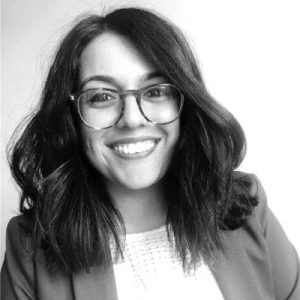


 Yona Isaacs (she/hers) is an Early Childhood Data Analyst for the Kids Count project. After earning her Bachelor of Science in Biopsychology, Cognition, and Neuroscience at the University of Michigan, she began her career as a research coordinator in pediatric psychiatry using data to understand the impacts of brain activity and genetics on children’s behavior and mental health symptoms. This work prompted an interest in exploring social determinants of health and the role of policy in promoting equitable opportunities for all children, families, and communities. She returned to the University of Michigan to complete her Masters in Social Work focused on Social Policy and Evaluation, during which she interned with the ACLU of Michigan’s policy and legislative team and assisted local nonprofit organizations in creating data and evaluation metrics. She currently serves as a coordinator for the Michigan Center for Youth Justice on a project aiming to increase placement options and enhance cultural competency within the juvenile justice system for LGBTQIA+ youth. Yona is eager to put her data skills to work at the League in support of data-driven policies that advocate for equitable access to healthcare, education, economic security, and opportunity for 0-5 year old children. In her free time, she enjoys tackling DIY house projects and trying new outdoor activities with her dog.
 Rachel Richards rejoined the League in December 2020 as the Fiscal Policy Director working on state budget and tax policies. Prior to returning to the League, she served as the Director of Legislative Affairs for the Michigan Department of Treasury, the tax policy analyst and Legislative Director for the Michigan League for Public Policy, and a policy analyst and the Appropriations Coordinator for the Democratic Caucus of the Michigan House of Representatives. She brings with her over a decade of experience in policies focused on economic opportunity, including workforce issues, tax, and state budget.
 Simon Marshall-Shah joined the Michigan League for Public Policy as a State Policy Fellow in August 2019. His work focuses on state policy as it relates to the budget, immigration, health care and other League policy priorities. Before joining the League, he worked in Washington, D.C. at the Association for Community Affiliated Plans (ACAP), providing federal policy and advocacy support to nonprofit, Medicaid health plans (Safety Net Health Plans) related to the ACA Marketplaces as well as Quality & Operations.

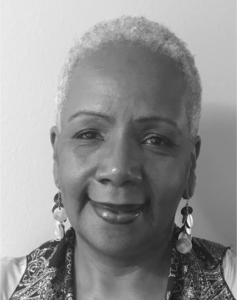 Renell Weathers, Michigan League for Public Policy (MLPP) Community Engagement Consultant. As community engagement consultant, Renell works with organizations throughout the state in connecting the impact of budget and tax policies to their communities. She is motivated by the belief that all children and adults deserve the opportunity to achieve their dreams regardless of race, ethnicity, religion or economic class.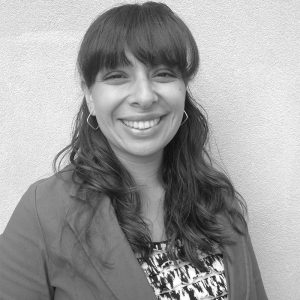


 Emily Jorgensen joined the Michigan League for Public Policy in July 2019. She deeply cares about the well-being of individuals and families and has a great love for Michigan. She is grateful that her position at the League enables her to combine these passions and work to help promote policies that will lead to better opportunities and security for all Michiganders.
 Megan Farnsworth joined the League’s staff in December 2022 as Executive Assistant. Megan is driven by work that is personally fulfilling, and feels honored to help support the work of an organization that pushes for more robust programming and opportunities for the residents of our state. She’s excited and motivated to gain overarching knowledge of the policies and agendas that the League supports.