The centerpiece of Governor Rick Snyder’s budget for the upcoming year is funding to address two crises that were long in the making and preventable—the exposure of thousands of Flint children to toxic lead in their drinking water and the unsafe conditions and looming insolvency of the Detroit Public Schools. These crises have exposed many governmental failures that must be fixed, and the governor’s budget lays out his short-term plan to do so.
The governor’s 2017 budget fails, however, to provide adequate, long-term solutions to infrastructure problems across the state, or reverse ongoing disinvestments in public services. There are many communities in Michigan that struggle to deliver the basic services needed to protect their residents from threats to health and safety. There are hotspots of lead poisoning all over the state, with 70% of lead exposure associated with paint in older homes. And school districts in both urban and rural areas are struggling financially as state funding has failed to keep pace with inflation or reflect rapidly declining enrollment.
Sadly, state policies have pushed more Michigan families into deep poverty. Stringent lifetime limits on public assistance, the ending of assistance for an entire family when one child is truant, and an asset test for food assistance all increase the chances that children will live in poorly maintained homes with lead paint, and make it more difficult for parents to provide the good nutrition that is known to mitigate the impact of lead exposure.
While the governor recommends important investments in the immediate needs of Flint and Detroit, there are challenges on the horizon. Serious threats to the state’s General Fund are approaching, including the cost of fixing the roads, changes in Medicaid financing that threaten the amount of federal revenue that the state can draw down, and the high cost of business tax credits. Long-term fixes to the problems in Flint, Detroit and other areas of the state that are achieved by dividing up a shrinking “budget pie” could set the stage for more crises and suffering down the road.
 Total Funding for 2017
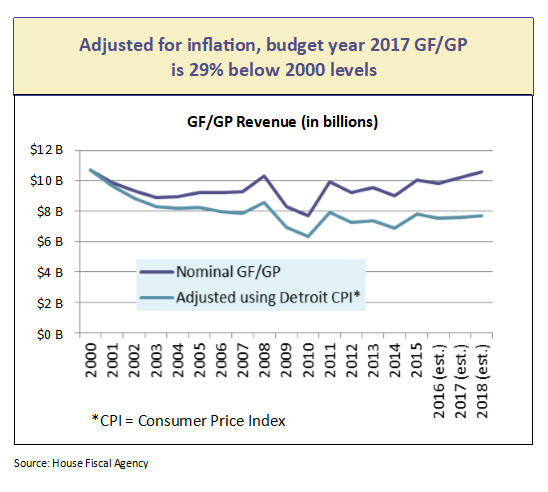
The governor recommends a total of $54.9 billion in spending for 2017, an increase of less than 1% over the current budget year. Four of every 10 dollars spent by the state are federal, with state general funds representing only 18%. The state’s General Fund (GF/GP)—the dollars over which the Legislature has the most discretion and control—are expected to be 29% below 2000 budget year levels when adjusted for inflation.
The Flint Water Crisis
The Legislature has already approved two funding increases for Flint in the current budget year totaling over $37 million. The funds are being used to reconnect Flint to the Detroit water system, provide bottled water and filters, allow Flint to hire additional school nurses and Early On staff to monitor children’s development, improve lead testing and abatement, increase services through child and adolescent healthcare centers and local community mental health, and boost food and nutrition programs. An additional $30 million is being sought to help defray Flint residents’ ongoing water bills until clean water can be guaranteed.
Over the two upcoming budget years (2017 and 2018), the governor recommends an additional $195 million in assistance to Flint for health and educational support, as well as infrastructure, with funding spread out over several state departments.
Highlights of the Governor’s 2017 Budget Proposal to Assist Flint
DEPARTMENT OF EDUCATION: The governor includes $8.1 million in federal Child Care and Development Fund dollars to:
- Expand half-day child care services to all children ages 0 to 3 in Flint, regardless of household income, at a cost of $8.1 million. Currently, parents must have incomes of less than 121% of the federal poverty line to be eligible for child care subsidies. The governor recommends that the child care eligibility expansion be implemented in the current budget year (also at $8.1 million).
- Provide information to child care providers on how to identify the effects of lead poisoning and intervene effectively ($50,000).
DEPARTMENT OF HEALTH AND HUMAN SERVICES: The governor recommends a total of $15.1 million in assistance to Flint through the Department of Health and Human Services (DHHS) budget in 2017. Additional funds would be available for the rest of 2017 if needed through a $50 million Flint Emergency Reserve Fund in the Department of Treasury, Management and Budget, or a $6.1 mil lion contingency fund in DHHS. Included are funds to:
- Expand nutrition services through food banks, the Women, Infants and Children program, and other existing nutrition programs ($4.7 million).
- Increase services in local child and adolescent health centers, along with DHHS staff in local schools (Pathways to Potential Program) to help connect children to available services ($1.1 million).
- Increase the capacity of local community mental health providers to evaluate and refer children with elevated lead blood levels ($6.9 million).
- Support lead investigations a plan for lead mitigation, and food inspection ($1.7 million).
K-12 SCHOOL AID: For 2017, the governor recommends slightly over $10 million in School Aid dollars for part-year services to the children of Flint. Additional funds would be available for the rest of the year if needed through a Flint Emergency Reserve Fund or a $15 million contingency fund. Funds would be used to:
- Continue to hire school nurses and social workers to help identify and intervene with children exposed to lead ($1.3 million).
- Strengthen services through the Early On program, which currently identifies children ages 0 to 3 with disabilities or developmental delays. The governor provides $950,000 for additional Early On and nutrition assistance staff, and $6.4 million for needed Early On services. The governor’s budget requires that all children be assessed at least twice annually for developmental delays. The governor also recommends $9.2 million in the current budget year for universal Early On assessments of Flint children ages 0 through 4.
- Expand the Great Start Readiness Program in Flint to all 4-year-olds regardless of income ($1.5 million).
The Crisis in the Detroit Public Schools
The Detroit Public Schools (DPS) financial crisis has been years in the making and the district now faces an estimated $515 million in operating debt, along with long-term liabilities related to deferred debts. The district is expected to run out of cash by the spring of this year. As the district has struggled financially, conditions in the schools have deteriorated placing children’s safety and educational progress in peril.
While DPS has been cutting costs, the district has over-spent in nine of the last 10 years, in part due to the rapid decline in students. Part of that decline was the result of the growth of charter schools in Detroit. Between 2007 and 2015, the percentage of Detroit children attending DPS decreased from 80% to 47%, while enrollment in charters increased from 20% to 53%. The end result is that enrollment in DPS has fallen 70% since 2003.1 With this large decline in enrollment, it is very difficult for any school district to adjust overhead spending quickly enough, and state payments to school districts have not been tailored to meet the needs of districts with declining enrollment.
To address the Detroit crisis, the governor proposes a three-part plan that includes:
- Maintaining the current school district as a vehicle to pay off the district’s debt, funded by the 18 mill property tax currently used for the school per-pupil foundation allowance.
- Establishing a new school district to operate the schools, completely funded with state funds.
- Creating a commission to hire a manager to oversee DPS and charter public schools in Detroit.
The governor proposes to pay off the DPS debt through the existing local school millage. To offset the loss of local funds, the governor recommends that $72 million from Michigan’s tobacco settlement proceeds be dedicated to DPS over the next 10 years, with the goal of avoiding cuts to other school districts. Tobacco settlement funds are currently used to support several programs including Medicaid and the Family Independence Program. Maintaining the state funds to hold those programs harmless will be important.
The Legislature is currently debating several versions of aid to DPS. On the table are proposals to use state General Fund or School Aid Fund dollars to help pay off the debt. If those approaches are adopted, additional cuts would be required in programs currently using those funding sources.
Health
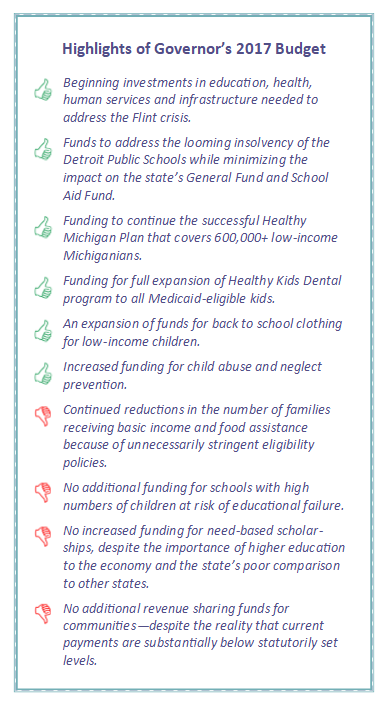
HEALTHY KIDS DENTAL: The governor recommends an investment of $8.9 million in state funds, $25.6 million in total funds to fully expand the Healthy Kids Dental program to the remaining Medicaid-eligible kids ages 13-20 in Kent, Oakland and Wayne counties. An estimated 131,000 children in the three counties will gain access to the program. Tooth decay remains the most prevalent chronic disease in children resulting in lost school days and diminished learning, as well as the potential for long-term negative health consequences.
HEALTHY MICHIGAN PLAN: The recommendation for the Healthy Michigan Plan includes the state funds required, nearly $109 million, when the federal funding declines from 100% to 95% effective January 1, 2017. The federal government approved the waiver on December 17, 2015, which allows the program to continue after April 30, 2016, for its 600,000-plus enrollees.
SPECIAL HOSPITAL PAYMENTS: The governor recommends continuation of the special payments to rural hospitals and the special obstetrical payments to stabilize obstetrical services implemented in budget year 2015. These special payments were eliminated in the 2016 Executive Budget, but were retained by the Legislature.
MENTAL HEALTH FUNDING AND BOILERPLATE:
- The governor’s 2017 budget includes continuation funding of $117 million for behavioral health services provided to those not eligible for Medicaid or the Healthy Michigan Plan.
- The governor’s budget includes boilerplate language that mandates all mental health and substance use disorder funding for Medicaid and Healthy Michigan Plan beneficiaries and autism services funding be transferred to the Medicaid Health Plan line item by September 30, 2017. The boilerplate requires the development of a plan to integrate behavioral health and physical health services, with stakeholder participation. It also requires the Medicaid health plans to contract with Community Mental Health Services Programs for specialty services and supports.
PUBLIC HEALTH: The governor recommends a $2 million increase in local public health funding for essential services.
Human Services
FOOD ASSISTANCE: The governor recommends a reduction of $71 million in federal funds from the current year budget for the Food Assistance Program (FAP) for low-income families and individuals, and projects that 795,000 families will need assistance next year. FAP is completely federally funded, with an average monthly benefit for a two-person household of $230.2 More than 70% of recipients receive no other cash assistance from the state. The number of people receiving food assistance began to fall in Michigan in 2011, the same year that the state imposed a new asset limit for recipients. Most states have moved away from asset limits, and Michigan is turning away significant federal dollars because of its adoption here.
 FAMILY INDEPENDENCE PROGRAM:
- Fewer families are receiving assistance: The governor projects that the number of families receiving cash assistance through the Family Independence Program (FIP) will continue to fall. Since 2011, more stringent lifetime limits for FIP have resulted in many families failing to receive needed assistance, with caseloads falling from nearly 80,000 families in 2011 to only 25,000 in 2016. The maximum monthly assistance for a family of three is $492, or less than one-third of the federal poverty level. The FIP grant is significantly less than the lowest fair market rent in all regions of the state.3
- Children’s clothing allowance is expanded: The governor expands the clothing allowance for children in families receiving FIP income assistance to include all children, not just those living with grandparents or other adults who are not eligible for FIP. In addition, the annual clothing allowance is increased from $140 per child to $200 (total cost of $6.1 million—all federal Temporary Assistance for Needy Families funding).
CHILD ABUSE AND NEGLECT:
- Prevention services: The governor included an increase of $10 million in one-time funding to expand the Parent Partner and Family Reunification Programs. The goals of the programs are to prevent the need for foster care, ensure that children are more quickly reunified with their families when it is safe to do so, and assist parents after children are returned home.
- Child welfare information system improvements: The state has been implementing a new information system that needs additional improvements to comply with federal regulations and be an effective tool for protective services and foster care workers. The governor recommends $22.3 million for improvements.
Child Care and Early Education
CHILD CARE: The governor recommends $124.2 million for child care services, including an increase of $8.1 million in both 2016 and 2017 for child care expansions in Flint. Statewide, the number of low-income families receiving child care subsidies fell by nearly 75% in the last decade—from 63,000 in 2006 to only 17,000 in 2015. Child care funding that communities and businesses need to keep low-wage parents on the job fell from $460 million to $105 million. The decline is partly the result of Michigan’s low child care eligibility and provider payment levels.
GREAT START READINESS PROGRAM: The governor recommends funding level for the Great Start Readiness preschool program ($243.6 million), allowing for 63,000 half-day slots for low-income 4-year-olds. Children are eligible if their family’s income is below 250% of poverty (300% if all children at 250% are served), with the priority given to children with the greatest needs. The governor adds language prioritizing services to homeless children, children in foster care and those in special education—regardless of family income.
INTERMEDIATE SCHOOL DISTRICT EARLY CHILDHOOD BLOCK GRANT: The governor recommends the continuation of funding for early childhood programs through the Intermediate School Districts ($13.4 million). Services are available for children from birth through age 8, with part of the money used to support Great Start collaboratives and parent coalitions around the state. An additional $2.5 million is continued for home visits for at-risk children and their families—part of the 3rd grade reading initiative adopted this year.
KINDERGARTEN ENTRY ASSESSMENT: Funding for the kindergarten entry assessment, which was a pilot project last year, has been removed. An alternate test is proposed that would be given to kindergartners in the spring.
K-12 Schools/Education
PER-PUPIL SPENDING: Two of every 3 dollars in the School Aid budget are used to support per-pupil pay ments, which are the primary source of funding for school operations. The governor recommends increases of between $60 and $120 per pupil, with districts receiving the lowest payment per pupil receiving the largest increases. The minimum per-pupil payment will increase to $7,511, while the maximum will rise to $8,229. With this change, the difference between the highest- and lowest-funded districts will be reduced to $778—down from a gap of $2,300 when Proposal A was first adopted.4
CONTINUED STUDENT DECLINE: The budget for 2017 assumes that there will be a decline of 9,800 students from the current school year. The number of K-12 students has been declining for more than a decade, translating into revenue losses for schools that cannot always reduce their costs as quickly. Since the 2002-2003 school year, the number of students in public schools has dropped 13%.5
FUNDING FOR STUDENTS ACADEMICALLY AT RISK: The governor recommends that funding for districts with high numbers of students who are at-risk academically be continued at the current year level ($379 million). Ongoing funding of $5.6 million is available for adolescent teen health centers and $5.2 million for hearing and vision screenings in schools. In the current year, the Legislature approved an increase of $70 million for the At-Risk Program—the first increase in over a decade. By statute, districts are supposed to receive a set amount of At-Risk dollars based on the number of children receiving free breakfast and lunch (130% of poverty). However, because the At-Risk Program has been underfunded by a total of $1.9 billion since 1995, districts receive much less. Fully funding the At-Risk Program this year would have cost an estimated $134 million more than was appropriated.6
READING BY 3rd GRADE: Funding for this year’s initiative to improve reading by 3rd grade is reduced by $2.5 million, from $26.4 million to $23.9 million, through the elimination of pilot projects and one-time funding. The largest component of the initiative—funding for additional instructional time for children who are behind in reading—is retained at $17.5 million. Also included are early literacy screening, teacher coaches and professional development.
LEAD TESTING IN SCHOOLS STATEWIDE: The governor recommends $9 million in the 2017 budget to reimburse school districts that voluntarily choose to test their water for lead levels. Another $9 million is proposed for the current budget year to ensure a quicker start to the program.
GRANTS FOR LOW-PERFORMING SCHOOLS: The governor includes $5 million in new funding for the lowest achieving 5% of public schools. Funds can be used for CEOs in the schools under the control of the State School Reform/Redesign Office ($1 million) as well as supplemental payments to schools ($4 million).
ADULT EDUCATION: The governor recommends flat funding for adult education programs ($25 million). This year, funding for adult education was increased by $3 million. However, over the past 20 years adult education funding was slashed from $185 million in 1996 to a low of $22 million in the 2014-2015 budget. While maintaining funding at current year levels, the governor recommends significant changes in eligibility and fund allocation for adult education programs, including the removal of the current cap on the payment amount ($2,850 per full-time participant) and the increase in eligibility to students with reading or math skills below the 12th grade (up from 9th grade).
Postsecondary Education
FINANCIAL AID: The governor recommends $2 million in new funding for the Tuition Incentive Program, which serves students from households that are eligible for Medicaid, bringing the total funding for the program to $50.5 million. The governor did not recommend increases for the two other grant programs, the Michigan Tuition Grant (which helps students attend private not-for-profit institutions) or the Student Competitive Scholarship, both of which are means-tested based on the amount a family needs to meet tuition levels rather than household income. The community college budget does not include funding for the Part-Time Independent Student Grant, which had been included in the 2016 budget, but was cut from the final budget.
TUITION RESTRAINT: Tuition restraint is a cap on the amount a university may increase tuition costs in order to receive full funding from the state. The governor recommends increasing the cap from 3.2% to 4.8%, enabling universities to increase tuition by a higher percentage than has been allowable in the past several years.
Community Revenue Sharing
STATUTORY REVENUE SHARING FOR CITIES, VILLAGES AND TOWNSHIPS: Michigan currently funds statutory revenue sharing at less than 30% of the statutorily set level, and the governor’s budget continues to underfund Michigan’s communities. The governor recommends $243 million in statutory revenue sharing for 486 cities, villages and townships, and maintains payments so long as they meet accountability and transparency requirements. However, the governor proposes to shift $5.8 million from current year one-time revenue sharing to a competitive grant program, which provides incentives to communities to consolidate programs and services and has not been funded in two years. This will eliminate payments to 101 communities and decrease payments to others.

COUNTY REVENUE SHARING AND INCENTIVE PROGRAM: The governor recommends $215.2 million to provide full funding to 78 eligible counties, up from 76 in the current year, so long as they meet accountability and transparency requirements.
Corrections
PRISON POPULATION: The governor’s budget for 2017 assumes that the Department of Corrections (DOC) will oversee an average prison population of 44,500 in the upcoming year, at a total state cost of just over $2 billion. Because criminal justice has been largely a state responsibility, about 97% of all spending in the DOC is from state dollars, with corrections spending accounting for nearly 1 in every 5 state General Fund dollars.
Michigan’s prison population rose from just under 18,000 in 1985 to a high of over 51,000 in 2006, dropping slightly in recent years. It costs the state $35,000 a year to house a prisoner, and the budget of the DOC is driven by the number of persons confined. While there have been a number of bipartisan efforts to reform the state’s criminal justice system and reduce the prison population, reform has been elusive. The possible solutions include reducing the number of offenders entering prison and the length of sentences, increasing the number of paroles and reinstituting credits for good behavior.7
HEALTHCARE SERVICES FOR PRISONERS:
- Hepatitis C drug treatments: The governor recom mends $17.3 million in state funds to cover the costs of new drugs for the treatment of prisoners with Hepatitis C—an increase of $3.4 million over current year funding of $13.9 million.
- Single vendor for managing prisoner physical and mental healthcare, and pharmaceuticals: The governor assumes that a consolidated contract for integrated healthcare, which is expected to be effective in June 2016, will result in savings of $3.8 million in the 2017 budget year, along with $1.6 million in savings in the current budget year.
- Funds to increase access to mental health services: The governor includes $2 million to address waiting lists for mental health services in prisons. Approximately 1 of every 5 prisoners currently receives some form of mental health treatment, and the number of prisoners diagnosed with mental illness has increased.
- Substance abuse services for probation violators: The governor recommends $750,000 for a new 30-day program to prevent relapse and serve as an alternative to residential treatment. Approximately 250 offenders will be treated.
PRISON REENTRY AND COMMUNITY SUPPORT: The governor reduced funding for reentry and community support programs by $2 million through the elimination of the Goodwill Flip the Script program, a Wayne County initiative that provided education, job training and mentoring to 800 youths and young adults to keep them out of prison. Also eliminated was a pilot program to prevent parole violations ($500,000).
Endnotes
1. Detroit Public Schools Financial Crisis, Citizens Research Council of Michigan (January 21, 2016).
2. Wild, V.B., HHS: Human Services Background Briefing, House Fiscal Agency (December 2015).
3. Information Packet: Program Specific Overviews of Public Assistance and Other Human Services Program Trends, Michigan Department of Health and Human Services (July 2015).
4. Wicksall, B., and Christensen, S., School Aid Background Briefing, House Fiscal Agency (January 2016). Does not include the foundation allowances of 37 hold harmless districts that are allowed to collect additional local millage revenue to maintain statutory foundation allowances above the State Guaranteed Maximum.
5. Ibid.
6. Summers, K., History of At-Risk Funding in Michigan, Senate Fiscal Agency (Summer 2015).
7. 10,000 fewer Michigan prisoners: Strategies to reach the goal, Citizens Alliance on Prisons & Public Spending (June 2015).

 Betsy Zobl-Tar
  Jay Cutler joined the League in March 2026 as the Kids Count Senior Data Analyst, where he collects, analyzes, and prepares data for Kids Count in Michigan.
 Danielle Taylor-Basemore joined the League as the Development Data and Stewardship Coordinator in June 2025. She brings with her five years of nonprofit experience with a special focus on community engagement, data visualization and strategic programming. Prior to joining the League, Danielle served as the Business District, Safety, and Digital Manager at Jefferson East, Inc.
 Scott Preston is a Senior Policy Analyst with the Michigan League for Public Policy, where he leads the organization’s immigration and criminal justice reform portfolios. In the three years prior to joining the League, Scott facilitated the Southeast Michigan Refugee Collaborative and managed a small business economic development program at Global Detroit. His work included launching Michigan’s first Refugee Film Festival and building on a trusted connector model that linked marginalized communities with crucial resources. Scott’s work at the League is informed by his background in journalism and research. He spent four years covering the Syrian refugee crisis in the Middle East for publications such as The Economist, and later worked with unaccompanied refugee minors through Samaritas. Scott holds a master’s degree in international migration and public policy from the London School of Economics and Political Science.
 Kate Powers joined the League as the Chief Development Officer in February 2025. Prior to joining the League, Kate held leadership positions at many Michigan nonprofit organizations, most recently serving as the COO and Chief Development Officer of Ele’s Place. Kate has spent the bulk of her career in fundraising, with a short stint in the state Legislature as a legislative aide to members in both chambers. Kate is a graduate of Michigan State University’s James Madison College with a Bachelor of Arts in Social Relations and has a certificate in fundraising management from the Lilly Family School of Philanthropy at Indiana University. Additionally, Kate served on the East Lansing Public Schools Board of Education and is a past President of the Junior League of Lansing. In her free time, she enjoys traveling with her husband and her son and saving outfit of the day and home decor ideas on Pinterest.
  Nicholas Hess joined the League as the Fiscal Policy Analyst in September of 2024. In this role, Nicholas focuses on tax policy, government revenue, and their impact on working families and racial equity, including the effects of the Earned Income Tax Credit (EITC) and Child Tax Credit (CTC). Nicholas values the role that judicious fiscal policy can play in the improvement of people’s lives and the economy, alleviating inequities along the way.
 Audrey Matusz joined the League as the Visual Communications Specialist in September 2024. She supports the team with implementing social media strategies and brainstorming creative ways to talk about public policy. She brings with her nearly a decade of experience in producing digital products for evidence-based social justice initiatives.
  Jacob Kaplan
  Donald Stuckey
  Alexandra Stamm
 Amari Fuller
 Mikell Frey is a communications professional with a passion for using the art of storytelling to positively impact lives. She strongly believes that positive social change can be inspired by the sharing of data-driven information coupled with the unique perspectives of people from all walks of life across Michigan, especially those who have faced extraordinary barriers.
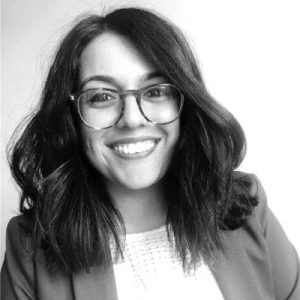


 Yona Isaacs (she/hers) is an Early Childhood Data Analyst for the Kids Count project. After earning her Bachelor of Science in Biopsychology, Cognition, and Neuroscience at the University of Michigan, she began her career as a research coordinator in pediatric psychiatry using data to understand the impacts of brain activity and genetics on children’s behavior and mental health symptoms. This work prompted an interest in exploring social determinants of health and the role of policy in promoting equitable opportunities for all children, families, and communities. She returned to the University of Michigan to complete her Masters in Social Work focused on Social Policy and Evaluation, during which she interned with the ACLU of Michigan’s policy and legislative team and assisted local nonprofit organizations in creating data and evaluation metrics. She currently serves as a coordinator for the Michigan Center for Youth Justice on a project aiming to increase placement options and enhance cultural competency within the juvenile justice system for LGBTQIA+ youth. Yona is eager to put her data skills to work at the League in support of data-driven policies that advocate for equitable access to healthcare, education, economic security, and opportunity for 0-5 year old children. In her free time, she enjoys tackling DIY house projects and trying new outdoor activities with her dog.
 Rachel Richards rejoined the League in December 2020 as the Fiscal Policy Director working on state budget and tax policies. Prior to returning to the League, she served as the Director of Legislative Affairs for the Michigan Department of Treasury, the tax policy analyst and Legislative Director for the Michigan League for Public Policy, and a policy analyst and the Appropriations Coordinator for the Democratic Caucus of the Michigan House of Representatives. She brings with her over a decade of experience in policies focused on economic opportunity, including workforce issues, tax, and state budget.
 Simon Marshall-Shah joined the Michigan League for Public Policy as a State Policy Fellow in August 2019. His work focuses on state policy as it relates to the budget, immigration, health care and other League policy priorities. Before joining the League, he worked in Washington, D.C. at the Association for Community Affiliated Plans (ACAP), providing federal policy and advocacy support to nonprofit, Medicaid health plans (Safety Net Health Plans) related to the ACA Marketplaces as well as Quality & Operations.

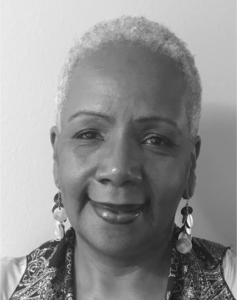 Renell Weathers, Michigan League for Public Policy (MLPP) Community Engagement Consultant. As community engagement consultant, Renell works with organizations throughout the state in connecting the impact of budget and tax policies to their communities. She is motivated by the belief that all children and adults deserve the opportunity to achieve their dreams regardless of race, ethnicity, religion or economic class.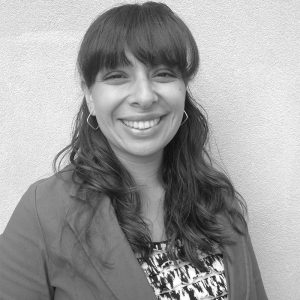

 Emily Jorgensen joined the Michigan League for Public Policy in July 2019. She deeply cares about the well-being of individuals and families and has a great love for Michigan. She is grateful that her position at the League enables her to combine these passions and work to help promote policies that will lead to better opportunities and security for all Michiganders.
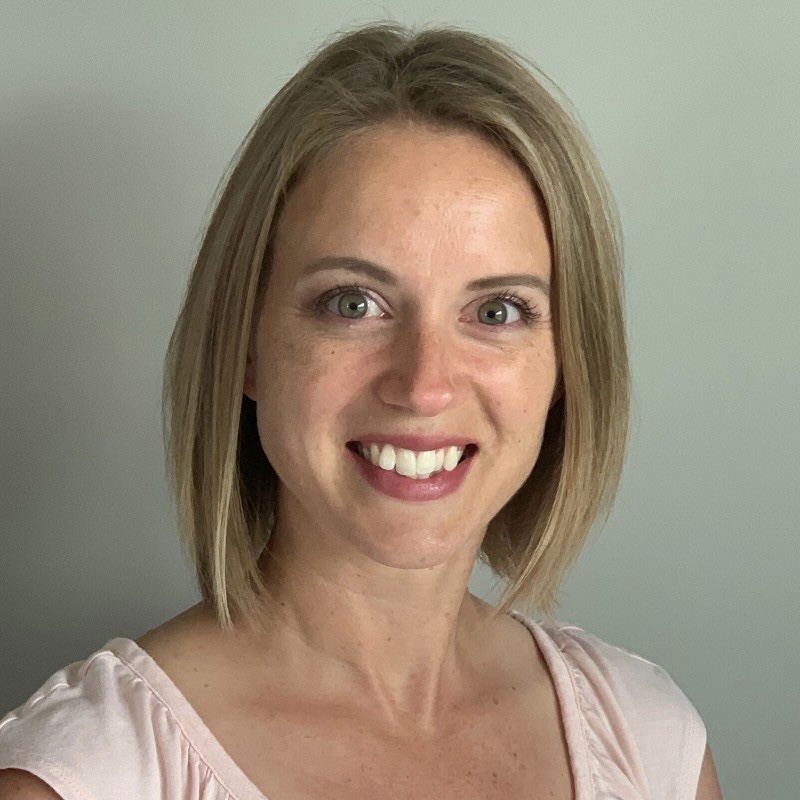 Megan Farnsworth joined the League’s staff in December 2022 as Executive Assistant. Megan is driven by work that is personally fulfilling, and feels honored to help support the work of an organization that pushes for more robust programming and opportunities for the residents of our state. She’s excited and motivated to gain overarching knowledge of the policies and agendas that the League supports.