
Michigan depends on its skilled workers, and much has been written and said about the need to build up our state’s workforce. Yet year after year in the state budget, state policymakers neglect to adequately fund adult education, making it less accessible for low-skilled workers who want to build their skills, become financially self-sufficient and contribute to Michigan’s economy. Adult education is the key to preparing these workers for occupational training and skilled employment, and better funding and an expanded role will enable it to meet the demand more effectively.
In the past, high school graduates could enter the middle class by getting jobs in the manufacturing sector immediately after graduation and moving eventually into skilled, higher-paying positions. Today, however, technological advances and offshore production have greatly decreased the need for unskilled, entry-level labor. A high school diploma by itself has far less value in the job market as a result, and employers increasingly prefer to hire skilled workers with a postsecondary credential such as a degree, certificate or license. With 9.7% of working age Michigan adults lacking a high school diploma, more than 230,000 adults not speaking English well, and more than half of community college students needing remediation, it is clear that too many workers have basic skill deficiencies that make it difficult to attain such credentials.
Expanding adult education services to help more low-skilled but highly motivated individuals succeed in post-secondary training will benefit Michigan. Skilled workers help attract and keep businesses in the state, spend more in their local communities, pay more in taxes, and are less likely to become unemployed or need public assistance. On the other hand, continuing to neglect adult education keeps a segment of the population out of the skilled labor pool, which in turns keeps the need for public assistance high, slows the revitalization of struggling communities and wastes an opportunity to increase state revenues.
 The Need for More Adult Education Services is Great
Adult education serves the segment of the population that does not have the basic skills necessary to gain secure, family-supporting employment, or to succeed in occupational training that leads to such employment. The term “basic skills” refers to the levels of reading, writing and mathematics that are associated with the attainment of a high school diploma and the ability to speak English proficiently. These skills are the foundation for building career-specific occupational skills that are in demand by the job market. While many adults without a high school diploma have deficiencies in one or more of these skill areas, some high school graduates also lose these skills over time or may not have completely mastered them while in high school. Adult education serves both sets of individuals.
Several indicators show that the number of working age adults needing adult education far surpasses those receiving it:
- Over 196,000 Michigan adults age 25-44 lack a high school diploma or GED, yet fewer than 9% have enrolled in adult education in most years.1
- More than 231,000 Michigan adults speak English less than “very well,” but barely more than 4% enroll in English as a Second Language adult education programs.2
- Between 55-65% of community college students each year need to take developmental (remedial) education classes due to having not mastered one or more skill areas needed for postsecondary education or training.3
It is clear that too few students are getting the basic skills education they need to be able to succeed in occupational training and ultimately, to find a pathway out of low-wage, dead-end jobs and into a skilled career that enables them to support their families and prosper. As Michigan’s workforce development efforts attempt to move an increasing number of low-skilled workers into postsecondary credential programs, the demand for adult education will become even greater and so will the need for funding. (For more detailed statewide and county indicators of need, please see Appendices 1-2.)

Adult Education Is a Crucial Link to Postsecondary Education and Gainful Employment
Because workers and job seekers without postsecondary occupational skills and credentials will have an increasingly difficult time finding family-supporting employment in coming years, the goal for adult education must not be merely to acquire a GED, but to transition workers into postsecondary training leading to a degree or certificate.
According to a report by the Georgetown University Center on Education and the Workforce, 70% of jobs in Michigan will require some level of postsecondary education by 2020, including 37% requiring a “middle skills” credential such as an associate degree (which typically takes two years) or a vocational certificate (which usually takes less than two years).4 The sector with the highest number of projected middle skills job openings in Michigan is sales and office support, (43,000 openings for workers with an associate degree and 104,000 openings for workers with a credential that takes less than two years). Other sectors with a large number of projected middle skills openings are food and personal services and what the report terms “blue collar” occupations such as agriculture, construction and production.5
 Helping low-skilled workers acquire postsecondary credentials that are in demand benefits not only those workers and their families, but also employers and the state as a whole. A skilled workforce will encourage businesses to stay, move to or expand in Michigan. Skilled workers earn and spend more money in their communities, which in turn helps other businesses and increases state revenues from income and sales taxes. Skilled workers are less likely to become unemployed or to need public assistance. Preparing more low-skilled workers for postsecondary training, therefore, needs to be a key component of Michigan’s work-force development strategy.
Michigan residents with “some college” or an associate degree have significantly higher earnings ($32,815) than those with only a high school diploma $27,926) and are less likely to be in poverty. The combined percentage of Michigan residents in the former category (32.9%), however, is barely higher than the percentage with only a high school diploma (29.3%), and well below the percentage without postsecondary education when those with less than a high school diploma (9.7%) are factored in. It is clear that many Michigan workers and their families would benefit from training leading to a postsecondary credential, and a significant number of those will need adult education to prepare them for such training. (Note: the “some college” category, in addition to including those who attained a certificate or license, includes those who took at least one postsecondary course but did not complete requirements for a credential. The earnings figures would likely be significantly higher if only credentialed workers are included.)
 One population that Michigan should actively target for adult education is its residents with limited English proficiency. A recent Working Poor Families Project report cites data showing that between 2010 and 2030, immigrant workers will account for more than 90% of the nation’s workforce growth and that by 2030, one in five workers will be an immigrant. Despite this, 70% of limited-English adults in the United States do not have education beyond high school and 44% do not have the equivalent of a high school diploma. Of foreign-born workers with a high school diploma but no postsecondary credential, those who are proficient in English earn 39% more than those who are not.6
In Michigan, 23% of adults 25 years and over who speak a language other than English at home (and 35% who speak Spanish at home) do not have a high school diploma, compared with 10% who speak only English at home. The poverty level is much higher for those who speak a language other than English (24%), especially for Spanish speakers (28%), than for those who speak only English (16%). With more than 230,000 adults in the state with limited English proficiency, Michigan should ensure that this population is targeted for adult education outreach and that there are adequate English as a Second Language programs—with adequate funding—in the areas of the state with the highest need.
 To Be More Effective, Adult Education Must Fit Family and Work Schedules
Adult education is primarily taught in school buildings, literacy centers, Michigan Works! one-stop centers, and public libraries. In some counties, it is provided at county jails, Head Start buildings or Community Action Agencies. Because instruction is usually provided at a central location rather than in the context of family, school and/or work, adult learners often must make child care arrangements or even adjust work schedules in order to attend adult education classes.
For some adult learners, this “traditional” way of receiving adult education instruction works. For others, however, the time needed to complete an adult education program conflicts with family or work needs and prolongs the time before entering into postsecondary training—increasing the likelihood that some students will drop out before completion. If the student lives or works a long distance from the school building, transportation can be an additional barrier.
Conversely, integrating adult education instruction into other aspects of students’ lives, such as work, occupational training and family, can make their experience more relevant, their course-work easier, and the time to complete a program shorter. All of this will increase the likelihood of student success, and in turn help the adult education system better meet the needs of employers.
There are several ways to contextualize the delivery of adult learning:
1.Use adult education as a two-generation strategy to improve the lives of both parents and children. A two-generation approach to fighting poverty devises programs and policies that seek to enhance children’s intellectual development in tandem with increasing their parents’ skills and ability to earn higher wages. Between 14% to 22% of adult education participants in recent years are public assistance recipients and 6% to 9% report that they are single parents.7 Yet public assistance recipients, parents of pre-school and school age children, and rural students have very poor program completion rates and all of these categories have declined since 2014.

Addressing the needs of these at-risk categories should be a top priority for both local program design and state policy. Examples of two-generation strategies on the program level include:
- Providing child care and enrichment activities at adult education sites.
- Offering adult education in programs such as Head Start that serve children (a very small number of counties in Michigan do this).
- Making sure that individuals who enroll in adult education are made aware of public assistance for which they may be eligible.
On the state level, Michigan can implement two-generation polices that make it easier for parents to access child care or be involved with their children’s education while receiving basic skills instruction, examples of which include:
- Making low-income adult education students categorically eligible for subsidized child care or raising the income eligibility level.
- Raising the child care subsidy level to a higher percentage of the market rate in order to cover more of the actual child care costs, and removing the paperwork barriers that discourage or prevent this population from making use of the subsidy even when eligible.8
- Making adult education services an integral part of all Pathways to Potential school programs.9
There are also steps Michigan can take to make it easier for parents on cash assistance to complete their GED. Unfortunately, federal rules do not let GED completion count toward recipient work requirements unless the recipient is also working 20 hours per week in another work activity such as paid employment or community service. Because success in GED completion may be hampered by the need to juggle classes, homework, family needs and 20 hours of work, Michigan should consider waiving the 20-hour work requirement. This would enable cash assistance recipients to take adult education classes full-time and attain their GEDs more quickly, or to tend to their children’s needs and intellectual development while completing their GED. Even though Michigan would not be able to count such recipients toward its work participation rate, the state has a high percentage of recipients meeting the requirements (61% in 2017) and can afford to be flexible in this area.10
 In addition, the Working Poor Families Project recommends two curriculum-based steps for states to consider as part of a two-generation strategy: 1) Expand and contextualize state-approved adult education curriculum to cover family financial literacy and asset-building instruction, and 2) Incentivize local providers of Adult Basic Education Literacy and English as a Second Language services to include opportunities for child-parent learning, such as family literacy and numeracy activities.11 Both of these strategies can be undertaken in Michigan, provided there is additional funding.
2. Provide adult education in the community colleges as an alternative to costly developmental education. Many community college students must take developmental education classes due to having not mastered one or more basic skill areas. Each year, well over half of community college students in Michigan are required to take at least one developmental education course. Such classes cost the same as for-credit classes leading to a degree or credential, costing the student money and/or using up some of the student’s financial aid resources. Providing developmental education to large numbers of students also can create difficulty for community colleges due to staff costs.
One way to solve this problem is for Michigan to allow (and provide funding for) community colleges and school districts to enter into cooperative agreements whereby students needing remediation can take adult education courses on the college campus that fulfill developmental education requirements. Because adult education is free, this will save the student money and underscore adult education’s important role as a transition program to postsecondary education.
3. Provide adult education in the workplace as a part of on-the-job training. Until 2004, when adult education received a large funding cut, programs were sometimes offered in automobile and other manufacturing worksites. This enabled employees who were held back from advancing in their jobs by reading, language or mathematics deficiencies to receive basic skills training at the workplace. Following the cuts, many counties and school districts discontinued the practice and until 2016-17, there were fewer than 50 adults who participated in workplace literacy programs in most years. Providing funding for on-site adult education serving low-skilled workers in their workplace (before or after work) can help workers avoid transportation barriers and save driving time, thus incentivizing them to participate.
4. Develop career pathway systems. Career pathways are ideally the best vehicle to deliver adult education. A career pathway is defined as “a well-articulated sequence of quality education and training offerings and supportive services that enable educationally underprepared youth and adults to advance over time to successively higher levels of education and employment in a given industry sector or occupation.”12 By linking basic skills training, career-specific occupational training, wraparound services (such as child care, transportation and/or financial services) and employment, they combine the three contextualized learning strategies discussed above.

Presently, if a low-skilled adult wants to acquire a credential and a skilled job, the required educational steps are usually sequential and mutually exclusive: first, the individual must participate in adult education to acquire a GED, then he or she must enroll in postsecondary education to acquire an occupational credential, and finally, he or she uses the newly gained credential to look for a job. Services are often provided in isolation, i.e. adult education is not used at community colleges in place of developmental education or integrated into on- the-job training.
By integrating the steps in the training sequence, career pathways enable low-skilled adults to learn basic skills in the context of occupational training leading to a credential; for example, English as a Second Language or high school mathematics is taught in a robotics or electrician training program leading to a certificate or license. Such programs shorten the time needed to obtain a postsecondary credential, because basic skills remediation is taught alongside of (or integrated into) occupational training rather than as a prerequisite. This is very important for adult learners with jobs and families, because the longer the time needed, the greater the likelihood of individuals dropping out prior to completion. Some career pathways programs provide supportive services such as child care, and some are directly connected to employment, with a guarantee of job placement upon successful completion.
Each of these expansions of adult education delivery will help adult learners persist in and complete their programs and will enable a larger number of individuals to participate. However, serving more people and serving them differently will require additional funding.
Michigan’s Shortsighted Neglect of Adult Education
Although the need for adult education is obvious, Michigan has undercut its accessibility in several ways, most notably in its drastic reduction of funding in 2004. This reduction was included in the then-governor’s budget and passed by the Legislature not due to a perceived decrease in need, but to reduce state spending during an especially tight budget period. Neither the current administration nor the Legislature has made an effort to restore the lost funding, even though the state has been in a generally stronger fiscal position for several years.
Following are the three ways Michigan has disinvested in this important workforce development tool:
State Appropriations: Michigan appropriated $80 million per year for adult education in Budget Years 1997 to 2001, decreased funding slightly in the following years, and then slashed funding to $20 million in Budget Year 2004. Adult education appropriations remained flat at $22 million for several years before being increased by small amounts to $24.7 million for Budget Year 2019 (after an administrative set-aside is subtracted)—a 69% reduction from 2001. Federal funding has not increased significantly to make up for the loss in state funding, so total funding for adult education in Michigan has dropped 59% since 2001, not accounting for inflation.
Administrative Set-Aside: In Budget Year 2015, the Legislature began the practice of setting aside 5% of the total adult education appropriation for regional administration of grant dollars, following a structural change in which adult education is now allocated through regional fiduciaries rather than directly to providers. This reduces the amount going to providers for teaching instruction and supports; for example, the appropriation of $26 million to adult education for 2019 is reduced to $24.7 million going to programs. While it may make sense to provide administrative funding to fiduciaries, the state should appropriate additional funds for this purpose rather than take it from adult education providers.
Erosion: When adjusted for inflation, the $24.7 million appropriated for 2018-19 was equal to only $17.4 million in 2001 dollars.13 In inflation-adjusted dollars, Michigan reduced its state funding by 78% between 2001 and 2019, causing total funding for adult education to drop by 71%.
Consequences of Adult Education Cuts
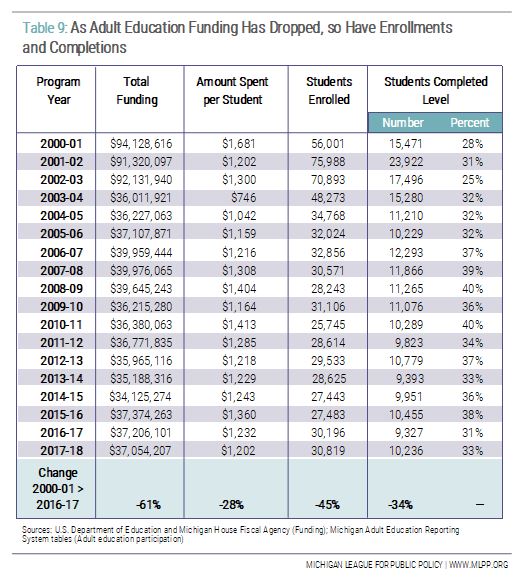
The funding cuts over the years have caused a drop in the number of students enrolling in, completing and advancing in adult education programs. Following the large funding reduction in the 2004 budget, student enrollment fell from more than 70,000 to less than 50,000, and is now just barely above 30,000. The number completing an academic level dropped from more than 15,000 (and nearly 24,000 in one year) to between 9,000 and 12,000 most years.14 The percentage of enrollees completing a level is generally between 30% and 40%, so there appears to be a direct correlation between the amount of funding and the number of students enrolling and completing.
 In addition to serving fewer students than in the past, Michigan does not compare well with other Midwest states on student participation or success measures. It ranks close to the bottom of states nationwide in the percent of students enrolled in adult education relative to those without a high school diploma or GED. It also ranks in the bottom half of states in the percent of students who improve in beginning literacy skills and who have a goal of postsecondary training, though of the students with that goal, the percentage who successfully transition to postsecondary is somewhat higher relative to other states.
Michigan needs to expand the number of programs available to adults who have not completed high school, and facilitate student success by providing adult education in contextualized contexts as discussed previously. Likewise, because beginning literacy students are among the least skilled and most economically vulnerable of adult education students, providing literacy instruction in the context of the workplace or as a two-generation strategy can help those participants succeed at higher rates.
 How Much Adult Education Funding is Needed?
Dividing the total funding appropriated each year for Program Years FY 2013-14 through 2017–18 by the number of students served each of those years shows that the state pays approximately $1,252 per individual adult education student. Unfortunately, because funding levels to districts are based on the previous year’s enrollments, districts that have more registrations than the prior year have to work with much less than $1,252 per student. This puts them in the position of having to either turn students away or to be constrained in the type of instruction they can offer or the materials they can use.
From Program Years 2013-14 through 2017-18, when adult education received state and federal funds totaling between $34 million and $38 million per year, the state served an average of 28,913 adult education students per year. Assuming a cost of $1,252 per student, if total funding were to be increased by $5 million, then the state could serve nearly 4,000 more students—a 14% increase to 32,908 students. If the 4,000 additional students were between the ages of 25 and 44, then the percentage of individuals that age without a high school diploma or GED who are enrolled in adult education would go from 6% to 9%.
Figure 10 shows approximately how many more students the adult education system could serve if funding is increased. (The table does not account for inflation.) While the Michigan League for Public Policy does not necessarily recommend that only adults age 25-44 without a high school diploma be targeted for additional money, the percent of this population that would be served with increased funding serves as a useful benchmark for measuring the degree that adult education meets the need in Michigan.

Recommendations
Increase Adult Education Funding
To ensure an adequate adult education funding base that will enable Michigan to meet the needs of its low-skilled workers and help them transition into postsecondary training, Michigan needs to:
- Increase adult education annual appropriations by $5 million to $25 million.
- Develop a formula for increasing adult education funding each year to keep up with inflation, rather than maintaining it at a flat level that will erode in value over time.
- Monitor developments in federal adult education funding and be prepared for any federal funding cuts in the future.
Provide Adult Education in Contextualized Environments
Low-skilled adults often have barriers that prevent them from participating or successfully completing adult education programs, and Michigan needs to try new ways to facilitate success for these learners. To connect adult education instruction with other aspects of students’ lives, Michigan should:
- Encourage and fund local adult education programs to offer classes in nontraditional settings such as community colleges, workplaces and sites in which parents can bring their children.
- Provide incentives for community colleges and school districts to enter into cooperative agreements in which adult education classes fulfill students’ developmental (remedial) education requirements, and remove any institutional barriers that prevent such cooperative agreements.
- Encourage employers to provide match funding for the provision of adult education instruction in the workplace.
- Encourage local adult education programs to become part of occupation-specific career pathway systems and provide funding for additional instructors.
Ensure that Adult Education is Part of the Pathway to Economic Security for Public Assistance Recipients
Public assistance recipients are among those with the greatest need for skill-building, which provides economic benefit to their families and positively affects their children’s skill development. To eliminate barriers that prevent members of this population from participating and successfully completing adult education programs, Michigan should:
- Allow adult education to satisfy Family Independence Program work requirements without imposing the federal requirement of 20 hours per week of other work activities. Michigan’s high work participation rate allows for some level of flexibility in this area.
- Build on the approach, begun under Governor Granholm with the Jobs, Education and Training (JET) program and expanded under Governor Snyder with the Partnership, Accountability, Training, Hope (PATH) program, of facilitating skill building for cash assistance recipients, while continuing to reject the “work first” philosophy that prioritizes short-term employment goals over long-term skill building and economic self-sufficiency.
Endnotes
- American Community Survey 1-year estimate, 2017.
- Ibid.
- State of Michigan Dashboard using data from the Michigan Community College Association. (https://midashboard.michigan.gov/education, accessed on October 5, 2017.)
- Carnevale, Anthony P., Nicole Smith and Jeff Strohl, Recovery: Job Growth and Education Requirements through 2020, Georgetown University Center on Education and the Workforce, June 2013.
- Ibid.
- Shaffer, Barry, Strengthening State Adult Education Policies for English as a Second Language Populations, Working Poor Families Project, Fall 2014.
- A student is counted as receiving public assistance if he or she is receiving financial assistance from federal, state or local government agencies. (Note: Social Security benefits, unemployment insurance, and employment-funded disability are not included under this definition.)
- For more information on the subsidy level and on the barriers preventing low-income parents from accessing Michigan’s child care subsidy, see Sorenson, Pat, Failure to Invest in High-Quality Child Care Hurts Children and State’s Economy, Michigan League for Public Policy, September 2014. (https://mlpp.org/failure-to-invest-in-high-quality-child-care-hurts-children-and-states-economy)
- Pathways to Potential, a Michigan Department of Health and Human Services program, uses the school environment to assist parents and children in attendance, education, health, safety and self-sufficiency. For more information on this program, go to http://www.michigan.gov/dhs.
- For more information on the federal work requirements in the Temporary Assistance for Needy Families program, see Michigan League for Public Policy, From Safety Net to Springboard: Using the Family Independence Program to Help More Parents Build Their Skills, December 2015. (https://mlpp.org/wp-content/uploads/2015/12/from-safety-net-to-springboard.pdf)
- Bassett, Meegan Dugan, Considering Two-Generation Strategies in the States, Working Poor Families Project, Summer 2014.
- Center for Law and Social Policy, The Alliance for Quality Career Pathways Approach: Developing Criteria and Metrics for Quality Career Pathways, February 2013.
- Figures are calculated using the Bureau of Labor Statistics’ Consumer Price Index inflation calculator (http://data.bls.gov/cgi-bin/cpicalc.pl).
- An academic level comprises two school grade levels.


 Jay Cutler joined the League in March 2026 as the Kids Count Senior Data Analyst, where he collects, analyzes, and prepares data for Kids Count in Michigan.
 Danielle Taylor-Basemore joined the League as the Development Data and Stewardship Coordinator in June 2025. She brings with her five years of nonprofit experience with a special focus on community engagement, data visualization and strategic programming. Prior to joining the League, Danielle served as the Business District, Safety, and Digital Manager at Jefferson East, Inc.
 Scott Preston is a Senior Policy Analyst with the Michigan League for Public Policy, where he leads the organization’s immigration and criminal justice reform portfolios. In the three years prior to joining the League, Scott facilitated the Southeast Michigan Refugee Collaborative and managed a small business economic development program at Global Detroit. His work included launching Michigan’s first Refugee Film Festival and building on a trusted connector model that linked marginalized communities with crucial resources. Scott’s work at the League is informed by his background in journalism and research. He spent four years covering the Syrian refugee crisis in the Middle East for publications such as The Economist, and later worked with unaccompanied refugee minors through Samaritas. Scott holds a master’s degree in international migration and public policy from the London School of Economics and Political Science.
 Kate Powers joined the League as the Chief Development Officer in February 2025. Prior to joining the League, Kate held leadership positions at many Michigan nonprofit organizations, most recently serving as the COO and Chief Development Officer of Ele’s Place. Kate has spent the bulk of her career in fundraising, with a short stint in the state Legislature as a legislative aide to members in both chambers. Kate is a graduate of Michigan State University’s James Madison College with a Bachelor of Arts in Social Relations and has a certificate in fundraising management from the Lilly Family School of Philanthropy at Indiana University. Additionally, Kate served on the East Lansing Public Schools Board of Education and is a past President of the Junior League of Lansing. In her free time, she enjoys traveling with her husband and her son and saving outfit of the day and home decor ideas on Pinterest.
  Nicholas Hess joined the League as the Fiscal Policy Analyst in September of 2024. In this role, Nicholas focuses on tax policy, government revenue, and their impact on working families and racial equity, including the effects of the Earned Income Tax Credit (EITC) and Child Tax Credit (CTC). Nicholas values the role that judicious fiscal policy can play in the improvement of people’s lives and the economy, alleviating inequities along the way.
 Audrey Matusz joined the League as the Visual Communications Specialist in September 2024. She supports the team with implementing social media strategies and brainstorming creative ways to talk about public policy. She brings with her nearly a decade of experience in producing digital products for evidence-based social justice initiatives.
  Jacob Kaplan
  Donald Stuckey
  Alexandra Stamm
 Amari Fuller
 Mikell Frey is a communications professional with a passion for using the art of storytelling to positively impact lives. She strongly believes that positive social change can be inspired by the sharing of data-driven information coupled with the unique perspectives of people from all walks of life across Michigan, especially those who have faced extraordinary barriers.



 Yona Isaacs (she/hers) is an Early Childhood Data Analyst for the Kids Count project. After earning her Bachelor of Science in Biopsychology, Cognition, and Neuroscience at the University of Michigan, she began her career as a research coordinator in pediatric psychiatry using data to understand the impacts of brain activity and genetics on children’s behavior and mental health symptoms. This work prompted an interest in exploring social determinants of health and the role of policy in promoting equitable opportunities for all children, families, and communities. She returned to the University of Michigan to complete her Masters in Social Work focused on Social Policy and Evaluation, during which she interned with the ACLU of Michigan’s policy and legislative team and assisted local nonprofit organizations in creating data and evaluation metrics. She currently serves as a coordinator for the Michigan Center for Youth Justice on a project aiming to increase placement options and enhance cultural competency within the juvenile justice system for LGBTQIA+ youth. Yona is eager to put her data skills to work at the League in support of data-driven policies that advocate for equitable access to healthcare, education, economic security, and opportunity for 0-5 year old children. In her free time, she enjoys tackling DIY house projects and trying new outdoor activities with her dog.
 Rachel Richards rejoined the League in December 2020 as the Fiscal Policy Director working on state budget and tax policies. Prior to returning to the League, she served as the Director of Legislative Affairs for the Michigan Department of Treasury, the tax policy analyst and Legislative Director for the Michigan League for Public Policy, and a policy analyst and the Appropriations Coordinator for the Democratic Caucus of the Michigan House of Representatives. She brings with her over a decade of experience in policies focused on economic opportunity, including workforce issues, tax, and state budget.
 Simon Marshall-Shah joined the Michigan League for Public Policy as a State Policy Fellow in August 2019. His work focuses on state policy as it relates to the budget, immigration, health care and other League policy priorities. Before joining the League, he worked in Washington, D.C. at the Association for Community Affiliated Plans (ACAP), providing federal policy and advocacy support to nonprofit, Medicaid health plans (Safety Net Health Plans) related to the ACA Marketplaces as well as Quality & Operations.

 Renell Weathers, Michigan League for Public Policy (MLPP) Community Engagement Consultant. As community engagement consultant, Renell works with organizations throughout the state in connecting the impact of budget and tax policies to their communities. She is motivated by the belief that all children and adults deserve the opportunity to achieve their dreams regardless of race, ethnicity, religion or economic class.


 Emily Jorgensen joined the Michigan League for Public Policy in July 2019. She deeply cares about the well-being of individuals and families and has a great love for Michigan. She is grateful that her position at the League enables her to combine these passions and work to help promote policies that will lead to better opportunities and security for all Michiganders.
 Megan Farnsworth joined the League’s staff in December 2022 as Executive Assistant. Megan is driven by work that is personally fulfilling, and feels honored to help support the work of an organization that pushes for more robust programming and opportunities for the residents of our state. She’s excited and motivated to gain overarching knowledge of the policies and agendas that the League supports.