In Michigan, it is common practice for courts to require people who have been arrested and are awaiting arraignment or sentencing to put up cash bail before releasing them from jail. This has ostensibly been to ensure that they will show up for required court dates and will not endanger others or commit further crimes prior to their hearings.
Unfortunately, in communities across Michigan, too many of those 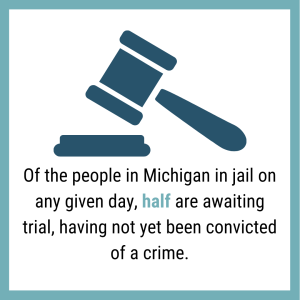 arrested for nonviolent crimes and who pose no threat to society needlessly stay in jail. Of the people in Michigan in jail on any given day, half are awaiting trial, having not yet been convicted of a crime.1 While some of those are kept detained because they are ineligible for bail due to a safety or flight risk, many remain incarcerated simply because they do not have the means to put up cash bail—including individuals later found to be innocent of the crime for which they were arrested. This practice disproportionately punishes people of color and those with low incomes, while having no benefit to the communities in which they live.
Representatives of the bail industry defend the current system using language intended to create fear that individuals who are released prior to trial without paying a cash sum will re-offend.2 These arguments make no sense and are misleading. Courts generally assess whether an individual is a public safety risk when determining whether he or she should be eligible for pretrial release at all, not when deciding whether the release should be based on personal recognizance or cash bail. A person who is a flight or safety risk will not be less so because of having the money to make bail, and the person who cannot make bail remains in jail not due to being a greater risk than the person who is free on bail, but because of having fewer financial resources.

Cash bail does not keep communities safe; it only keeps the less privileged among us in jail. Although individuals across the economic spectrum get arrested, the cash bail system is starkly stacked against arrestees in the lower income levels. Nationally, over 60% of arrested individuals unable to post bail fall within the one-third of society with the lowest incomes, and 80% are in the bottom half.3 A 2015 study found that people unable to post bail had a median annual income of $15,109 (in 2015 dollars) prior to their incarceration, which was less than half of the median income for non-incarcerated people of similar ages.4 Individuals of means, on the other hand, are much more likely to have the necessary cash bail amount readily available and can thus leave jail quickly without enlisting the help (and subjecting themselves to the expense) of a bail bond company.
Because the application of bail requirements is inconsistent across communities and because bail bond services target individuals with limited incomes and resources, the current bail system also disproportionately affects Black Michigan residents. First, the respective median annual incomes of Black men and women who are unable to make bail are significantly lower than their White and Hispanic counterparts, and Black men and women have significantly higher income gaps than the other racial groups between those who are unable to make bail and those who are not incarcerated.5
There are other racial disparities in the cash bail system that are not as easily attributable to income status. A recent literature review of various city and county studies across the nation found that Black and Brown defendants are 10-25% more likely than White defendants to be detained pretrial or to receive financial conditions of release.6 Moreover, median bond amounts for Black defendants are often about $10,000 higher than for White defendants.7
Michigan must address, and ultimately put an end to, this bias against its residents with low incomes and few resources and its residents of color.

The consequences of having to remain in jail until arraignment or even sentencing due to not having bail money can be devastating to individuals and their families. It can result in the loss of a job, financial hardship due to missing work, disrupted family and social relations, and trauma for family members. It is especially harmful for children who are placed into Child Protective Services custody while their parent remains in jail simply due to inability to post bail.
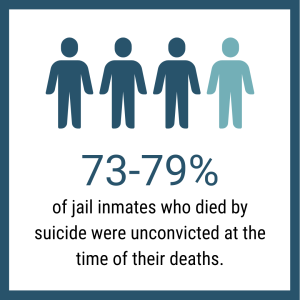 Extended jail stays prior to trial and conviction—whether due to cash bail unaffordability or a perceived flight or safety risk—are detrimental to mental health as well. Michigan had 172 suicides in its jails between 2000 and 2019.8 While there is no state-level data available about the conviction status of those individuals, national data for those years shows that 73-79% of jail inmates who died by suicide were unconvicted at the time of their deaths.9
An extended jail stay due to inability to post cash bail has been found to weaken an arrestee’s bargaining positions during plea negotiations, leading to a higher likelihood of a guilty plea and ultimately jeopardizing the defendant’s chance of a fair outcome.10 This may be connected to the finding that low-risk defendants who are detained for the entire pretrial period are more likely to be sentenced to jail or prison when compared to their counterparts who are released at some point before trial or case disposition.11 A study also concluded that individuals who are detained pretrial are more likely to commit future crimes.12 In other words, cash bail requirements and the inability for some individuals to meet them have the potential to interfere with the cause of justice.
For arrestees who are able to make bail and avoid a jail stay as they await their hearings, the process of paying a high bail amount can result in financial hardship or debt, since they do not get the money returned until after their deposition hearing. If they go through a bail bond company in order to post bail, they only receive 90% of the bail money posted, since such companies generally keep around 10% of the bail total as a non-refundable fee.

The problem of the excessive use of pretrial incarceration and bail requirements did not happen by itself. Despite political concern going back at least as far as the 1960s about the “war on the poor” created by the cash bail system, the system remains largely in place in most parts of the country.13 Nationally, the bail bond industry has been estimated to back around $14 billion in bail bonds a year, generating revenues estimated at $1.4 billion.14  Unsurprisingly, it remains one of the staunchest foes of bail reform, engaging in intensive lobbying on the state and national level against meaningful cash bail reform.
In Michigan and around the country, bail companies and the insurance firms that back them intensely lobby lawmakers to keep the status quo and contribute to their election campaigns. In 2020, for example, one political action committee funded primarily by bail and pawnbroking interests contributed $25,000 directly to the campaign of a candidate for judge and contributed more than $20,000 in ads on behalf of a candidate for county prosecutor.15

In 2019, Gov. Whitmer established the Michigan Joint Task Force on Jail and Pretrial Incarceration and gave it the charge of evaluating Michigan’s justice systems and crafting recommendations for statewide policy and budgetary changes.16 The task force was chaired by the Chief Justice of the Supreme Court and made up of representatives from state departments, legislators from both parties, law enforcement, county elected officials, judges and others.17
The task force addressed many issues of corrections and incarceration and issued recommendations. As part of its work, it wrote up six recommendations for reform in the area of pretrial incarceration and bail, and there is currently a package of bills in the Legislature that would put those recommendations into law.

There is a bipartisan groundswell of support for reforming the way cash bail is set and other aspects of pretrial incarceration, such as limiting the time between an arrest and arraignment or trial. On October 21, 2021, Michigan lawmakers from both parties introduced the following package of bills in the State House of Representatives addressing these issues. Following is a very brief summary of each of the bills (the bill language itself along with other information can be found in the links):
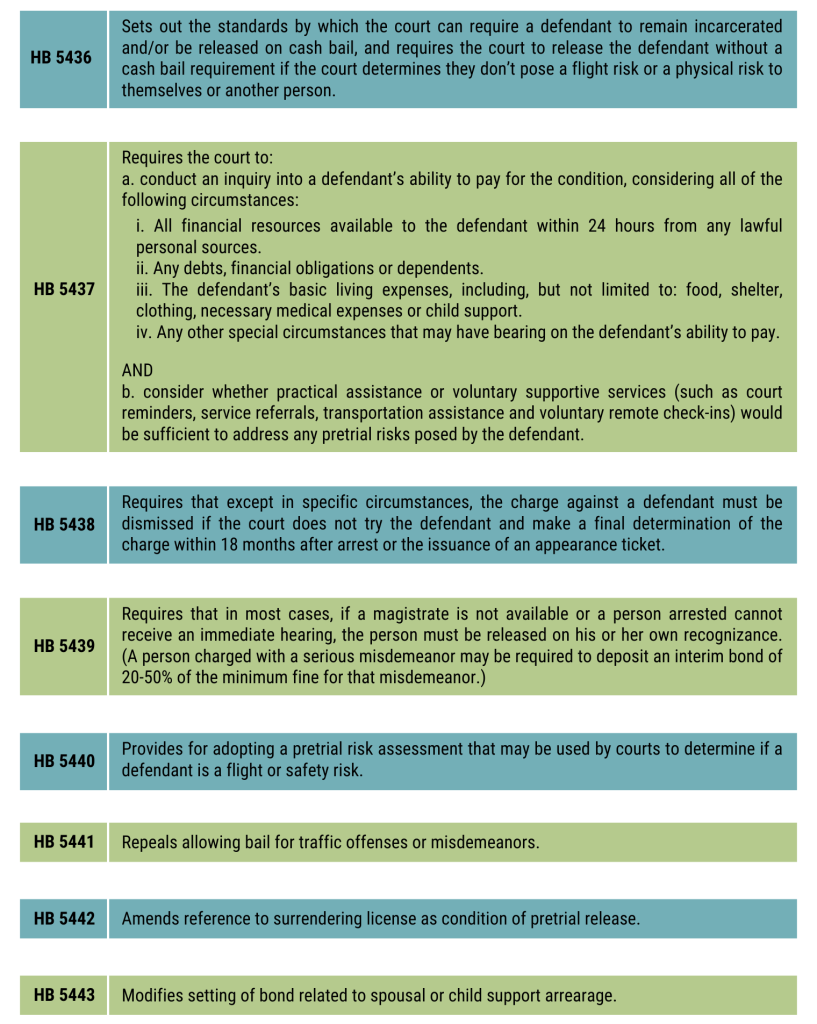
The Michigan Legislature should act quickly to consider and pass these bills, and turn a new leaf in Michigan on behalf of residents who are detained prior to receiving a trial.

1 Michigan Joint Task Force on Jail and Pretrial Incarceration: Report and Recommendations, January 10, 2020.
2 Website of the American Bail Coalition (https://ambailcoalition.org/category/michigan, accessed on October 14, 2021).
3 Rabuy, B. & D. Kopf, Detaining the Poor, Prison Policy Initiative, May 2016.
4 Rabuy, ibid.
5 Rabuy, ibid.
6 Sawyer, W., Briefing: How Race Impacts who is Detained Pretrial, Prison Policy Initiative, October 9, 2019.
7 Sawyer, ibid.
8 Carson, E. A., Suicide in Local Jails and State and Federal Prisons, 2000–2019 – Statistical Tables, Bureau of Justice Statistics, October 2021.
9 Carson, ibid.
10 Dobbie, W., J. Goldin & C. Yang, The Effects of Pre-Trial Detention on Conviction, Future Crime, and Employment: Evidence from Randomly Assigned Judges, National Bureau of Economic Research, United States Department of Treasury, August 2017.
11 Lowencamp, C., M. VanNostrand & A. Holsinger, Investigating the Impact of Pretrial Detention on Sentencing Outcomes, Arnold Foundation, November 2013.
12 Heaton, P., S. Mayson & M. Stevenson, The Downstream Consequences of Misdemeanor Pretrial Detention, Stanford Law Review, Volume 69, March 2017.
13 For example, see President Johnson’s remarks at the signing of the Bail Reform Act of 1966. Website of University of California, Santa Barbara’s American Presidency Project (https://www.presidency.ucsb.edu/documents/remarks-the-signing-the-bail-reform-act-1966, accessed on October 18, 2021).
14 American Civil Liberties Union, Selling Off Our Freedom: How Insurance Corporations Have Taken Over Our Bail System, May 2017.
15 Website of the Secretary of State, Michigan Campaign Finance Searchable Database: “Bail PAC Statement of Organization” (https://cfrsearch.nictusa.com/committees/519202, accessed on October 19, 2021).
16 The Office of Governor Gretchen Whitmer, Executive Order No. 2019-10 (https://www.michigan.gov/whitmer/0,9309,7-387-90499_90705-495399–,00.html, accessed on September 30, 2021).
17 Jail and Pretrial Reform page of the website of Michigan Courts (https://www.courts.michigan.gov/administration/special-initiatives/jail-advisory-council, accessed on October 8, 2021).


 Jay Cutler joined the League in March 2026 as the Kids Count Senior Data Analyst, where he collects, analyzes, and prepares data for Kids Count in Michigan.
 Danielle Taylor-Basemore joined the League as the Development Data and Stewardship Coordinator in June 2025. She brings with her five years of nonprofit experience with a special focus on community engagement, data visualization and strategic programming. Prior to joining the League, Danielle served as the Business District, Safety, and Digital Manager at Jefferson East, Inc.
 Scott Preston is a Senior Policy Analyst with the Michigan League for Public Policy, where he leads the organization’s immigration and criminal justice reform portfolios. In the three years prior to joining the League, Scott facilitated the Southeast Michigan Refugee Collaborative and managed a small business economic development program at Global Detroit. His work included launching Michigan’s first Refugee Film Festival and building on a trusted connector model that linked marginalized communities with crucial resources. Scott’s work at the League is informed by his background in journalism and research. He spent four years covering the Syrian refugee crisis in the Middle East for publications such as The Economist, and later worked with unaccompanied refugee minors through Samaritas. Scott holds a master’s degree in international migration and public policy from the London School of Economics and Political Science.
 Kate Powers joined the League as the Chief Development Officer in February 2025. Prior to joining the League, Kate held leadership positions at many Michigan nonprofit organizations, most recently serving as the COO and Chief Development Officer of Ele’s Place. Kate has spent the bulk of her career in fundraising, with a short stint in the state Legislature as a legislative aide to members in both chambers. Kate is a graduate of Michigan State University’s James Madison College with a Bachelor of Arts in Social Relations and has a certificate in fundraising management from the Lilly Family School of Philanthropy at Indiana University. Additionally, Kate served on the East Lansing Public Schools Board of Education and is a past President of the Junior League of Lansing. In her free time, she enjoys traveling with her husband and her son and saving outfit of the day and home decor ideas on Pinterest.
  Nicholas Hess joined the League as the Fiscal Policy Analyst in September of 2024. In this role, Nicholas focuses on tax policy, government revenue, and their impact on working families and racial equity, including the effects of the Earned Income Tax Credit (EITC) and Child Tax Credit (CTC). Nicholas values the role that judicious fiscal policy can play in the improvement of people’s lives and the economy, alleviating inequities along the way.
 Audrey Matusz joined the League as the Visual Communications Specialist in September 2024. She supports the team with implementing social media strategies and brainstorming creative ways to talk about public policy. She brings with her nearly a decade of experience in producing digital products for evidence-based social justice initiatives.
  Jacob Kaplan
  Donald Stuckey
  Alexandra Stamm
 Amari Fuller
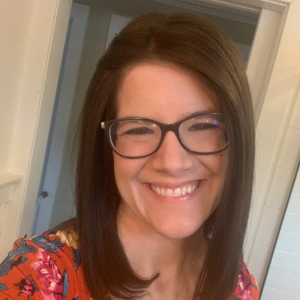 Mikell Frey is a communications professional with a passion for using the art of storytelling to positively impact lives. She strongly believes that positive social change can be inspired by the sharing of data-driven information coupled with the unique perspectives of people from all walks of life across Michigan, especially those who have faced extraordinary barriers.



 Yona Isaacs (she/hers) is an Early Childhood Data Analyst for the Kids Count project. After earning her Bachelor of Science in Biopsychology, Cognition, and Neuroscience at the University of Michigan, she began her career as a research coordinator in pediatric psychiatry using data to understand the impacts of brain activity and genetics on children’s behavior and mental health symptoms. This work prompted an interest in exploring social determinants of health and the role of policy in promoting equitable opportunities for all children, families, and communities. She returned to the University of Michigan to complete her Masters in Social Work focused on Social Policy and Evaluation, during which she interned with the ACLU of Michigan’s policy and legislative team and assisted local nonprofit organizations in creating data and evaluation metrics. She currently serves as a coordinator for the Michigan Center for Youth Justice on a project aiming to increase placement options and enhance cultural competency within the juvenile justice system for LGBTQIA+ youth. Yona is eager to put her data skills to work at the League in support of data-driven policies that advocate for equitable access to healthcare, education, economic security, and opportunity for 0-5 year old children. In her free time, she enjoys tackling DIY house projects and trying new outdoor activities with her dog.
 Rachel Richards rejoined the League in December 2020 as the Fiscal Policy Director working on state budget and tax policies. Prior to returning to the League, she served as the Director of Legislative Affairs for the Michigan Department of Treasury, the tax policy analyst and Legislative Director for the Michigan League for Public Policy, and a policy analyst and the Appropriations Coordinator for the Democratic Caucus of the Michigan House of Representatives. She brings with her over a decade of experience in policies focused on economic opportunity, including workforce issues, tax, and state budget.
 Simon Marshall-Shah joined the Michigan League for Public Policy as a State Policy Fellow in August 2019. His work focuses on state policy as it relates to the budget, immigration, health care and other League policy priorities. Before joining the League, he worked in Washington, D.C. at the Association for Community Affiliated Plans (ACAP), providing federal policy and advocacy support to nonprofit, Medicaid health plans (Safety Net Health Plans) related to the ACA Marketplaces as well as Quality & Operations.

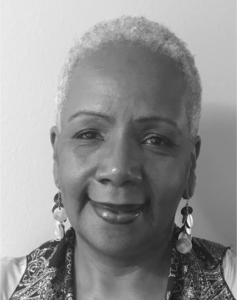 Renell Weathers, Michigan League for Public Policy (MLPP) Community Engagement Consultant. As community engagement consultant, Renell works with organizations throughout the state in connecting the impact of budget and tax policies to their communities. She is motivated by the belief that all children and adults deserve the opportunity to achieve their dreams regardless of race, ethnicity, religion or economic class.
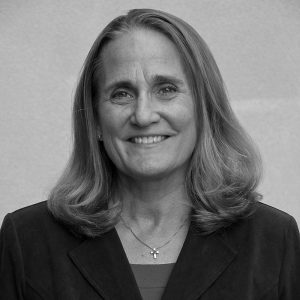


 Emily Jorgensen joined the Michigan League for Public Policy in July 2019. She deeply cares about the well-being of individuals and families and has a great love for Michigan. She is grateful that her position at the League enables her to combine these passions and work to help promote policies that will lead to better opportunities and security for all Michiganders.
 Megan Farnsworth joined the League’s staff in December 2022 as Executive Assistant. Megan is driven by work that is personally fulfilling, and feels honored to help support the work of an organization that pushes for more robust programming and opportunities for the residents of our state. She’s excited and motivated to gain overarching knowledge of the policies and agendas that the League supports.